The stock market has been in shaky territory lately, and the Federal Reserve could complicate matters further.
The S&P 500 (^GSPC -0.71%), Dow Jones Industrial Average (^DJI -0.79%), and Nasdaq Composite (^IXIC -1.03%) have essentially flattened in recent months, with tech sector volatility, oil prices, and inflation concerns all fueling uncertainty.
Last week, Kevin Warsh delivered a much-anticipated speech at his first Jackson Hole, Wyoming, conference as Federal Reserve chair. While he, as expected, declined to offer forward guidance, he did express concern about stubbornly high inflation, noting that “we have work to do.” Here’s why investors may want to prepare for potential volatility.

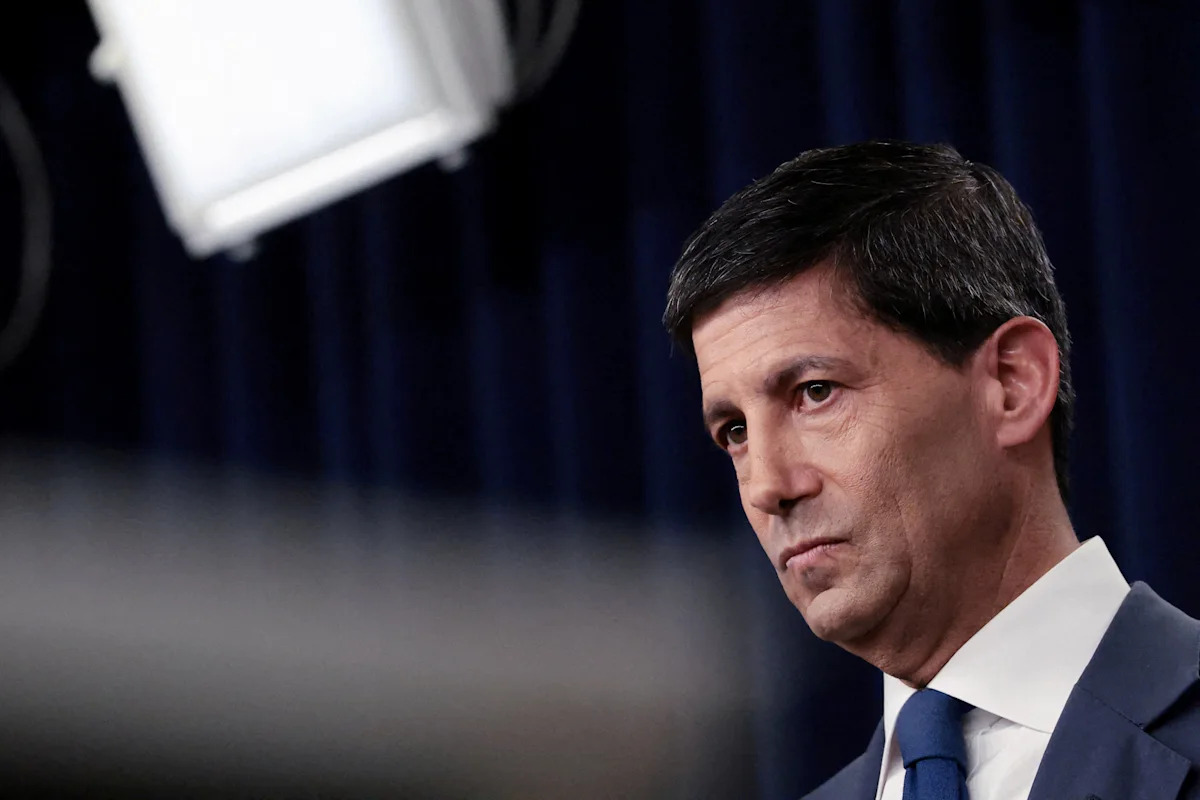
Image source: Official Federal Reserve photo.
Will the Fed raise interest rates in 2026?
Investors have been concerned about interest rate increases for months, especially with Warsh’s hawkish reputation preceding him. But those worries have eased lately, as a weaker-than-expected July jobs report suggested the Fed may be more likely to keep rates low for now.
During Warsh’s keynote speech in Jackson Hole, however, he offered a rare insight into the strength of the economy, noting, “I would be hard pressed to describe broad financial conditions as restrictive.” Warsh added that despite the shaky jobs report, “labor markets are consistent with full employment.”
This leaves the other side of the Fed’s job: keeping inflation low. Higher unemployment tends to benefit from low interest rates, while rate hikes can help keep surging inflation in check. With Warsh signaling that the labor market is not a major concern right now, there’s little reason to avoid rate hikes.
While Warsh didn’t go so far as to suggest that a hike is imminent, he emphasized that the Fed will need to act to curb inflation.
“The responsibility for 65 months of sustained, elevated inflation sits squarely with the central bank,” he said. “We must be confident that underlying inflation is moving to our objective, clearly and at sufficient speed. Otherwise, we have work to do.”
A rate hike could hurt the stock market
Generally speaking, interest rate hikes tend to be unfavorable to the stock market, but they could be even more troubling right now.
Artificial intelligence (AI) stocks have been behind much of the market’s recent gains, as tech companies spend hundreds of billions of dollars building AI-related data centers and other infrastructure. If borrowing becomes more expensive thanks to higher interest rates, these companies could pull back on spending.
Concerns around an AI bubble are already ramping up, as the market becomes increasingly concentrated. The 10 largest companies in the S&P 500 make up around 40% of the index’s total value, and most of those companies — including Nvidia, Apple, Amazon, Microsoft, and Alphabet — have been taking huge swings on AI.
In other words, the Fed’s rate decision could have a ripple effect throughout the rest of the market. If big tech companies pull back on AI spending, those stocks could stumble. And because mega-cap tech stocks make up such a large portion of the S&P 500, they could potentially bring the rest of the market down with them.
History has encouraging news for investors
It’s still uncertain how the Fed will act later this year, but current projections indicate a 68% chance it will raise rates during its September meeting, according to CME Group‘s FedWatch tool. That’s up from 41% just one week ago.
The good news is that even if a recession or bear market is looming, the broader market has a flawless track record of recovering from volatility. In fact, the S&P 500 has earned positive total returns over every 20-year period since 1919, according to data from Crestmont Research.
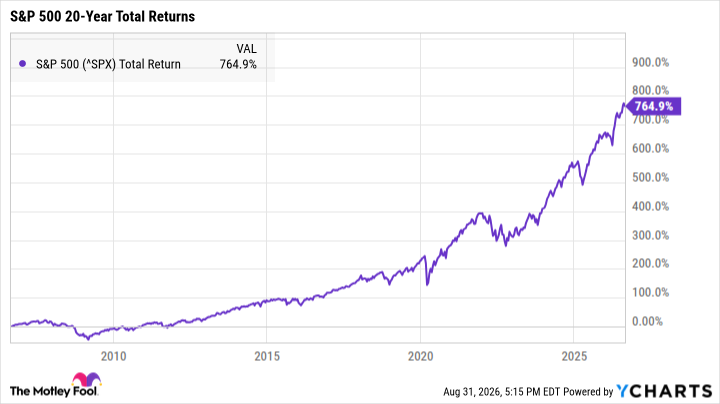
In the last two decades alone, the market has faced historic volatility — from the Great Recession to the COVID-19 crash to the 2022 bear market. Despite all of this turbulence, however, the S&P 500 has soared by nearly 765% since August 2006.
Not all companies will survive a downturn, and even healthy stocks can be hit hard during a bear market. But history has repeatedly proven that long-term investors are the best positioned to build substantial wealth, no matter how the market fares in the near term.