Market snapshot
- ASX 200: -1.1% to 8,963 points
- Australian dollar: flat at 71.4 US cents
- Wall Street: Dow Jones (-0.8%), S&P 500 (-0.7%), Nasdaq Composite (-1%)
- Europe: FTSE (-0.3%), DAX (-1.1%), Stoxx 600 (-0.6%)
- Asia: KOSPI (-2.7%)
- Spot gold: -0.2% to $US4,320/ounce
- Oil (Brent futures): +0.7% to $US95.35/barrel
- Iron ore (Singapore): -0.3% at $US99.25/tonne
- Bitcoin: -0.1% to $US77,350
Prices current at around 10:15am AEST
Live updates on the major ASX indices:
Two Telstra engineers on leave at time of July outage
The long-awaited report into what caused Telstra’s national outage on July 8 has dropped this morning, with the investigation finding two of the telco’s key engineers responsible were on mandatory leave at the time.
The outage was triggered at 2:50am after a faulty power supply was replaced and reset a timing mechanism, which resulted in a date change that flowed through the network.
It resulted in hundreds of people being unable to call Triple Zero, small businesses being unable to use eftpos, and stopped trains in NSW and Victoria.
The independent external review, conducted by Technology Audit Partners, found that there was “not sufficient knowledgeable staff” who could identify the error in the timing system that caused the outage, and the alarms that had picked up the issue were only checked during business hours.
On a media briefing call this morning, Telstra CEO Vicki Brady accepted the findings and said the telco is focused on implementing changes to ensure the outage doesn’t happen again.
Mining sell-off drags ASX significantly lower, gold price falls to one-month low
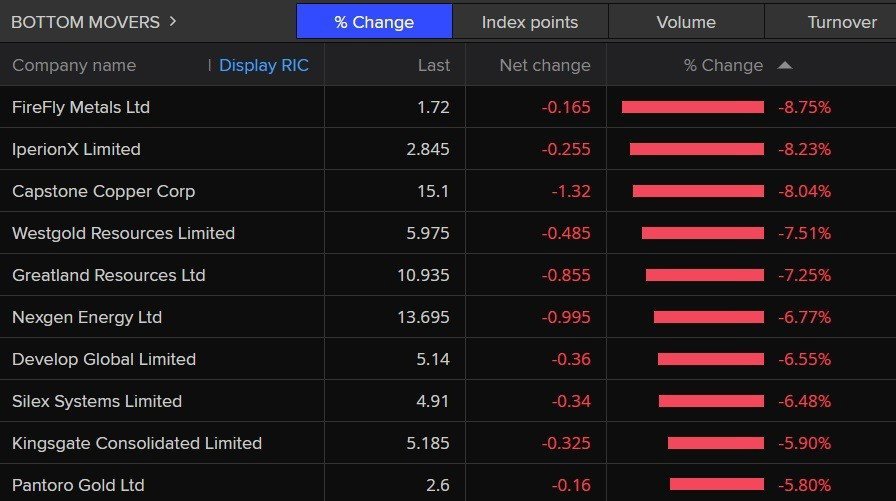
Some of today’s worst performing stocks are gold miners.
That was after the precious metal’s spot price dropped to a one-month low of $US4,314 an ounce.
It’s because the odds of a US Federal Reserve interest rate in September have risen to around 68%.
Higher rates is bad news for non-yielding assets like gold and other lumps of metal.
Pantoro Gold, Westgold and Kingsgate shares are faring poorly, with losses of around 6% to 7.5%, while copper miner Capstone Copper (-8%) is also being sold off.
The iron ore mining giants, however, have a bigger weighting on the share market.
Shares of BHP (-3.4%), Rio Tinto (-2%), and Fortescue (-3.2%) are also down sharply.
Democracy (and its opponents)
G’day Michael. Always interested in Gareth’s articles. He’s been concentrating on the thought processes of billionaires for a while. I find Gil Duran’s thoughts a bit obvious though. We all have our view on how the world should be run and certainly if I was a billionaire I’d be using my money to promote my viewpoint as I think we all would. As far as attacking democracy goes , we don’t have it at the moment. We don’t select the Governor General or the Prime Minister and we have no power to enforce the commitments made by politicians. We should be using technology to swivel from a ‘parliamentary’ democracy to a ‘direct’ democracy where citizens vote online on legislation proposals , using individual myGov id , removing vast layers of bureaucrats and legislators and preventing the billionaire intervention Durán fears.
– Phillip
Thanks Phillip.
I’d be really interested in your thoughts of the book, if you end up reading it. It provides far more detail about the history of their ideas, and how their ideas have evolved, than I could fit into that piece.
Regarding your idea of direct democracy, the economist Nicholas Gruen has been steadily thinking his way through possible ways to make our democracy more effective (on substack), which I think you’d appreciate.
e.g. this piece.
Australian share market’s losses worsen to around 1.5 per cent
The Australian share market’s losses have worsened after its first hour of trade.
The ASX 200 is down 1.4% to 8,939 points.
The broader All Ords index is doing a bit worse. It has fallen 1.5% to 9,127 points.
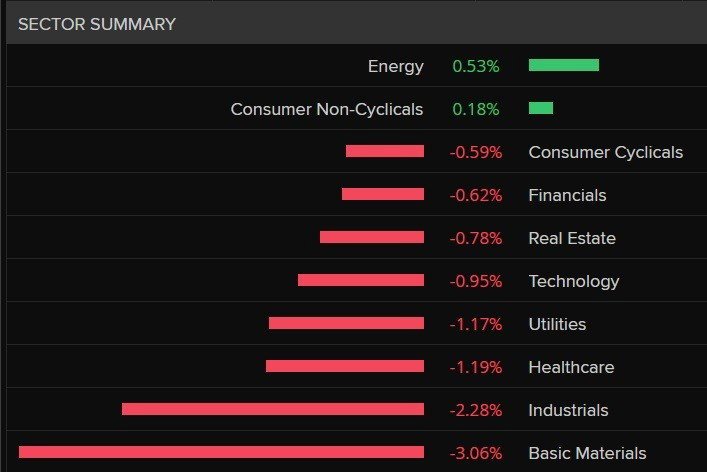
Almost every sector is trading lower, with materials (-3%) and industrials (-2.3%) still the worst performers.
The only sector doing really well is energy (+0.5%), thanks to the 5% surge in oil prices overnight as US-Iran hostilities escalated significantly.
AI will be deflationary in the long-term, says US investment giant
The head of a major US investment firm says those adopting AI now are already starting to see some productivity gains, though it can be “hit and miss”.
On last night’s The Business, host Kirsten Aiken interviewed Northern Trust Asset Management’s president Michael Hunstad who manages $US1.8 trillion worth of funds.
Kirsten asked him whether the cost of establishing data centres and buying into AI technology will make the fight against inflation more difficult for business,
“I think over the short term that may be true, but over the longer term I’m a firm believer that AI may be the biggest positive supply shock that the global economy has ever seen,” Mr Hunstad said.
He added that will ultimately be deflationary in the sense it will “bring unit price costs down”.
You can listen to their full interview here:
Loading…
Australia’s 10-year borrowing costs have risen to highest level since 2011
As I mentioned earlier, Australia’s long-term borrowing costs have risen to their highest level since 2011 due to the bond sell-off.
The yield on the government’s 10-year bond yield has risen to 5.19 per cent.
If you want to know why this is bad news and how it affects your mortgage and other interest rates, here’s a great explainer by David Taylor:
Global bond sell-off pushes governments’ borrowing costs to their highest level in years
A sell-off in global bond markets has worsened, reflecting investor angst over inflation and government debt levels that stand to inflict fresh pain on consumers and businesses.
When investors sell their bonds they’re essentially demanding higher compensation for what they see as higher inflation risks.
That causes the bond price to fall and its yield, or interest rate, to rise. And it leads to higher borrowing costs for governments.
Here’s what’s happening on bonds across several countries:
- The Australian government’s 10-year bond yield has risen to 5.19%, its highest level in 15 years
- Japan’s 10-year bond yield hit 3% for the first time since 1996 as the rout hit bond prices
- Yields hit their highest in 15 years in Germany
- The UK’s long-term borrowing costs are at their highest since 2008
- In the US, the 10-year yield rose 3.8 basis points to 4.8%, putting it in range of its highest level since 2023
Some of the world’s leading economies, notably the US, have sharply increased their debt loads in recent years through deficit spending, with US debt hitting $US40 trillion.
This structural deficit will be difficult to remedy without tough choices by the US government. For instance, spending cuts and rolling back tax cuts for the wealthy may be options, but they would be politically unsavoury.
On top of that, wars from Russia-Ukraine to the Middle East have sent oil and gas prices higher, adding to pressure on interest rates and the cost of living.
– with Reuters
ASX drops 1pc in opening trade with most sectors lower
We’re just over five minutes into the trading day and the Australian share market is already off to a bad start.
The ASX 200 index has fallen 1.1% to 8,968 points.
Almost every sector is trading lower, with materials (-2.7%) and industrials (-2.1%) being the worst performers.
On the flip side, the energy sector (+1.4%) is soaring after the latest US-Iran escalation pushed oil prices to their highest level in two months.
Property prices drop further as downturn spreads to 93pc of capital city suburbs
Property prices have dropped for a fifth straight month, with the slump unlikely to be ending any time soon. Especially if the Reserve Bank lifts interest rates again, which is seen as likely to happen.
The property price downturn has also spread to around 93% of Australia’s capital city suburbs, according to the latest data from Cotality.
The housing market has been hit by several headwinds including three RBA’s interest rate hikes this year and the federal government’s decision to restrict negative gearing and increase capital gains tax.
For more, here’s the story by Jasper Wells:
Loading…
Markets recap: Alan Kohler’s finance report
If you need a refresher before the ASX opens for trading, I can certainly recommend Alan Kohler’s finance report.
Among other things, Alan talked about why the Australian government’s long-term borrowing costs have surged to a 15-year high and house prices are falling for a fifth straight month.
Loading…
‘Sudden shift’ towards pessimism likely to result in falls across ASX banking and property shares
In less than an hour the Australian share market will start trading and it will likely be a fairly significant loss.
ASX futures are pointing to an opening fall of around 0.9%, though there’s a chance it might not be that bad.
“The catalyst for the sudden shift in sentiment stems from escalating Middle East tensions following strikes near the Strait of Hormuz, raising immediate concerns over potential bottlenecks in critical global shipping channels,” said Moomoo Australia’s chief market strategist Tapas Strickland.
“Higher energy costs risk re-igniting headline inflation just as central banks seek confirmation that price pressures are contained.
“While higher bond yields are expected to weigh on rate-sensitive growth stocks, banks, and real estate, local energy producers and materials heavyweights should offer critical support as elevated crude and firm commodity prices keep resources in demand.”
If the ASX follows the trends on Wall Street overnight, then it looks like tech stocks will perform badly while oil and gas stocks should do well.
“US technology stocks led the overnight retreat, with notable sell-offs in CrowdStrike, Dell, and Cadence Design, which all dropped more than 6.5%, alongside declines in Tesla (-3.2%) and Palantir (-3.5%),” Mr Stickland said.
“However, the session was not entirely one-directional; defensive and energy-exposed names provided counterweight, with Exxon Mobil gaining 2.2%, Johnson & Johnson rising 2%, Moderna surging 10%, and Apple climbing 2.6%.
“The divergence highlights an increasingly selective market environment where high-multiple tech bears the brunt of yield pressures.”
How ‘the Nerd Reich’ is waging a war against democracy
A really interesting column from Gareth Hutchens based on an interview he did last week with US journalist and author Gil Durán, who has recently published The Nerd Reich: Silicon Valley Fascism and the War on Democracy.
The title really sums up Durán’s thesis, which is that many tech billionaires want to usher in a post-democracy era, where they control their own pockets of society.
This is well worth a read and we’re interested in your thoughts. Please share in the comments.
AI boom’s demand for skilled workers could hit housing pipeline
Australia lacks enough workers to build both houses and data centres in its pipeline, and new data shows the artificial intelligence boom will worsen this shortfall.
The Powering Skills Organisation (PSO), a government-established jobs and skills commission, has warned that already-high competition for workers has been accelerated.
The report, released on Wednesday, estimates Australia needs an additional 72,000 electricians, technicians and related tradespeople by 2030 to meet projected demand.
Last year, the same report forecast a shortage of 42,000 energy workers.
A key driver of the widening gap is the rapid growth in data centre construction, expected to be worth about $150 billion by the end of the decade, according to Treasury.
For more, here’s the story by Ewa Staszewska:
Bathla has potential to be largest housing collapse Australia has ever seen
The potential collapse of property developer Bathla Group is a “disaster” for buyers, subcontractors and lenders.
Some are claiming it might be the largest housing collapse in Australian history.
Michael Akkawi, the founder and CEO of prominent developer Conquest says “it would be second only to the HIH collapse” in 2001.
“This is actually larger than the Babcock collapse back in 2009.
“Based on the numbers that they’re reporting at the moment, it’s circa $3.6 billion in debt, when you add the layers of subcontractors, suppliers, tax debt, and everyone else in the food chain, that number could be astronomically higher.”
Ultimately, Mr Akkawi believes Bathla will go into liquidation, and says the wider problems of high construction costs, government tax changes and interest rate hikes are a “wake-up call” for the industry.
You can listen to his full interview with The Business host Kirsten Aiken here:
Loading…
Markets rattled by major escalation in US-Iran war
It’s fair to say the latest developments on the US-Iran war are a major escalation of their six-month-long conflict.
The US military has launched new attacks on Iran, with explosions reported in cities along the Strait of Hormuz.
US President Donald Trump has posted on his social media channel about the fresh wave of attacks, saying it was retaliation for Iran’s attempts to place sea mines in the Strait.
An Islamic Revolutionary Guard Corps (IRGC) spokesperson warned that the US “will regret its new attacks”, saying “severe punishment awaits the aggressors”.
The IRGC then said it launched an attack on Jordan with ballistic missiles.
Jordan’s military says its air defences intercepted 10 of 13 ballistic missiles that entered the kingdom’s airspace.
So that’s why oil prices surged, and it explains why the Australian share market will probably have a bad trading day.
For the latest updates, I can highly recommend the ABC’s Iran war blog here:
Gold falls sharply as stocks on Wall Street and Europe close lower
The latest escalation between US and Iranian forces has led to oil prices surging and government bonds being sold off — which drove yields to multi-year highs.
This also led to a stronger US dollar as the odds of a rate hike in September have risen sharply.
The flow-on effect was a sharp fall in the gold price. The precious metal’s spot price dropped 2.7% to $US4,329 an ounce.
On Wall Street, the Dow Jones index fell 0.8% to 52,767 points, the S&P 500 lost 0.7%, to 7,631 points, while the Nasdaq Composite dropped 1%, to 26,100 points.
In Europe, Britain’s FTSE (-0.3%), Germany’s DAX (-1.1%) and the pan-European Stoxx 600 (-0.6%) indices dropped as well.
How Coles and NSW Police busted an Apple gift card tampering scam
Earlier this week, we brought you an ABC investigation into gift cards being tampered with, then sold to unsuspecting consumers at Australia’s largest supermarkets.
It has left shoppers confused and stressed, raising questions about whether this is linked to a multi-billion-dollar criminal scam.
Our reporters Emilia Terzon and Jasper Wells have a follow-up to that story.
They reveal how Coles discovered it was being defrauded by a scammer — and how the Police tracked down and arrested him. It’s a riveting read!
ASX to open lower as renewed US-Iran fighting sparks inflation fears
Good morning, and welcome to the ABC’s finance blog! I’ll be guiding you through the latest market action for the next few hours.
It appears the Australian share market is on track to fall quite sharply when it opens in just over two hours.
ASX futures, which are a rough indicator of how the market may open, have dropped 0.9%.
So what’s behind this pessimism?
For starters, the latest escalation in US-Iran hostilities has driven oil prices to a two-month high on fading hopes that this war will end any time soon.
Brent crude futures jumped 5.3% to $US95.26 per barrel. The price of this oil benchmark shot up by around $US4.70 in just a few hours.
That, in turn, had led to renewed worries about surging inflation. And that led to a global bond sell-off, which pushed yields to multi-year highs.
Essentially, investors have been selling off their holdings of government debt and are demanding a higher return.
The US 10-year Treasury bond yield rose as high as 4.8% overnight, to its highest level since January 2025.
And the flow-on effect was a stronger US dollar, especially given the odds of the Federal Reserve lifting America’s interest rates at the end of September rose to 68%, so it’s looking more likely than not.
The stronger greenback led to the Australian dollar falling slightly to 70.5 US cents.
Anyway, please grab a coffee, tea or whatever you normally have in the morning, and I’ll have more updates for you shortly!
Market snapshot
- ASX futures: -0.9% to 8,934 points
- ASX 200 (Tuesday close): -0.1% to 9,067 points
- Australian dollar: -0.3% to 71.5 US cents
- Wall Street: Dow Jones (-0.8%), S&P 500 (-0.7%), Nasdaq Composite (-1%)
- Europe: FTSE (-0.3%), DAX (-1.1%), Stoxx 600 (-0.6%)
- Spot gold: -2.7% to $US4,329/ounce
- Oil (Brent futures): +5.2% to $US95.15/barrel
- Iron ore (Singapore): flat at $US99.45/tonne
- Bitcoin: -1.5% to $US77,410
Prices current at around 7:30am AEST