The Australian share market is rising strongly, while the Australian dollar is at four-year highs.
Shares in JB Hi-Fi are under pressure after the retailer lifted quarterly sales but warned of an uncertain environment and supplier cost increases.
Follow the day’s financial news and insights from our reporters on our live blog.
Disclaimer: This blog is not intended as investment advice.
Market snapshot
- ASX 200: +1.3% to 8,793 points
- Australian dollar: +0.7% to 72.34 US cents
- Dow Jones: +0.7% to 49,298 points
- S&P 500: +0.8% to 7,259 points
- Nasdaq: +1.3% to 28,015 points
- FTSE: -1.4% to 10,219 points
- EuroStoxx: +0.7% to 610 points
- Spot gold: +2.3% at $US4,661/ounce
- Brent crude: -1.4% to $US108.39/barrel
- Iron ore: +1.7% to $US110.95/tonne
- Bitcoin: -0.2%% at $US81,488
Prices current at 5:20pm AEST
ASX 200 surges 1.3pc in best session in nearly a month
The Australian share market has enjoyed a big bounce after some recent losses, with the ASX 200 rising 1.3%.
That’s our best gain since the 2.6% rise back on April 8, so nearly bang on a month.
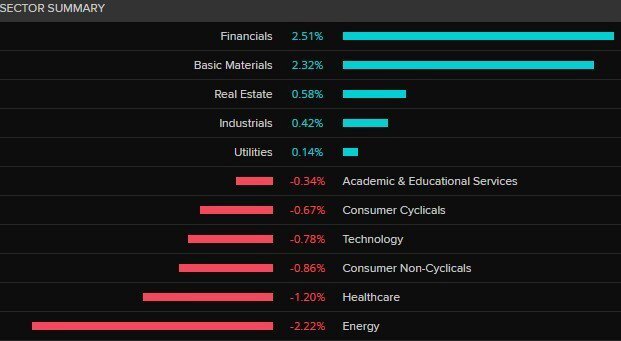
The major banks did a lot of the heavy lifting, with financials the best performing sector:
Looking at how individual stocks fared, there were some big gains:
- Infratil +15%
- IGO +6.6%
- Liontown +6.3%
- Sims +5.5%
- Downer EDI +4.7%
There were also some big falls:
- Magellan Financial Group -8.9%
- JB Hi-Fi -6.3%
- Life360 -5.9%
- 4DMedical -5.5%
- Lottery Corporation -5%
Big Mac index highlights ‘inflation problem’
How’s the Big Mac index looking?
– Hamburglar
Hamburglar,
I have to say you, scared me as a kid.
But moving on.
I think a Swiss Big Mac sells for $7. The US price is $5.79.
An Australian Big Mac is $7.90.
This is consistent with Australia’s “inflation problem”, as many have put it, and the elevated Australian dollar.
NAB note on Australian agricultural inputs
NAB commodity strategist Vince Carse has just penned these key points on agricultural inputs in a note this afternoon:
- The conflict in the Middle East has had a substantial impact on prices for key agricultural inputs such as diesel and urea.
- While prices are off the peaks, they remain well above pre-conflict levels.
- Australia is more exposed to disruptions to Middle Eastern fuel and fertiliser supply than other large grain-producing countries, owing to its reliance on imports from the region.
- While input prices are rising, for now, most agricultural prices are little changed. However, rationing of fertiliser use, reduced cropping, and substitution could cause agricultural output prices to rise in the medium term.
Major banks outperform
All four big banks performed well on the stock market today.
They were up between 2 and 4 per cent.
It follows a move by the Reserve Bank to increase the cash rate by 0.25 percentage points to 4.35%.
In addition, there appears to be some sector rotation out of energy and into financials.
The broader market mood was also positive.
The S&P/ASX 200 closed up 113 points, or 1.3% to 8,793.
Australian dollar surge
Let’s just revisit this surge in the Australian dollar today.
It’s clearly — what financial market participants call — a “risk on” trading day.
The US futures market is also up after both the S&P 500 and Nasdaq posted record highs.
Investors are looking past the geopolitical risks and are focused on the returns afforded by the big seven tech stocks in the US, often called the Magnificent Seven.
Combine this with Australia’s relatively high interest rates and support for the local currency is clear.
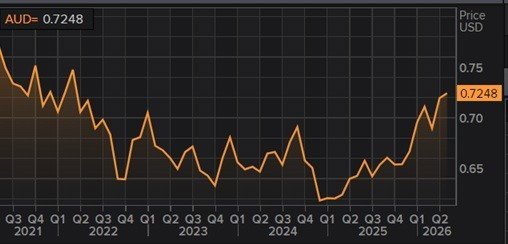
This chart gives you a sense of where the currency is trading relative to recent history.
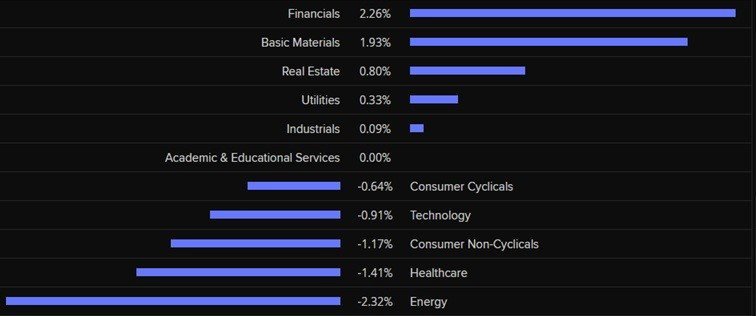
ASX sector rotation
The sector rotation on the ASX 200 today is quite pronounced.
It’s worth noting, though, that despite money leaving the energy sector as oil prices retreat, more money is pouring into banks, miners and real estate vehicles.
Oil price retreat stalls
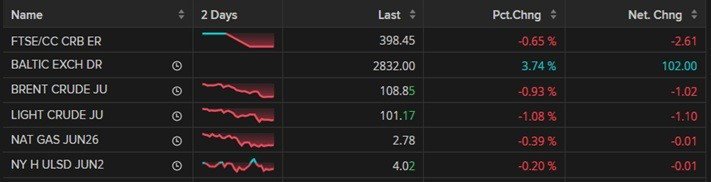
Oil prices fell in early Asian trade today.
While the benchmark Brent crude is still on the back foot, futures contracts seem to have found support at $108 a barrel.
Here’s a market snapshot.
ASX rallies into the close
The Australian share market has picked up steam in the final hour of trade.
At 3:20pm, the S&P/ASX 200 was up over 1% to 8,773.
It puts the index back to about 4% below its all-time high reached in February.
The banks are being bid up, but the energy sector is on the nose.
Is Australia on the brink of a recession?
Is Australia on the brink of a recession?
– James
Hi James,
One definition of a recession is “six consecutive months of negative growth” (that is, two quarters in a row).
If we were to experience a recession this year (on that definition), and if it “started” in the June quarter we’re currently living in, the period of negative growth would have to run uninterrupted until October before it was belatedly recognised as a recession.
The Reserve Bank is currently forecasting a significant slowdown in economic activity this year.
It expects the annual rate of growth in Australia’s economy to halve from 2.6% (currently) to 1.3% (by the end of 2026).
Then, it’s forecasting the economy’s annual growth rate to barely increase for the next 18 months after that (June 2027: 1.3%, Dec 2027: 1.4%, June 2028: 1.4%).
In the RBA’s 78-page Statement on Monetary Policy yesterday, which contains those forecasts above, the word “recession” wasn’t used once.
So, even though we may not experience a technical recession, such a rapid slowdown in growth followed by a prolonged period of anaemic growth (and rising unemployment) could very easily feel like one for many people.
Australian dollar surges — it’s ‘the vibe’
The Australian dollar has surged 1% to surpass a four-year high of 72.48 US cents.
The local currency reached 72.47 US cents on April 18, 2022.
Tuesday’s Reserve Bank 0.25 percentage point interest rate hike consolidated the dollar’s recent rally.
But commentary from RBA governor Michele Bullock that the central bank was concerned about the price impacts of the Iran war and building inflation expectations, seems to have pushed the dollar to levels not seen since early 2022.
“The vibe around the Aussie dollar has completely flipped this year, broadly aligning with the RBA’s reversal on interest rates,” InTouch senior FX analyst Sean Callow said.
“It is up 8.5% so far this year, outperforming almost all major currencies, backed by the rising yield it offers.
“Beyond interest rates, the Aussie remains supported by investor optimism that the energy price shock will not derail the global economy.
“Investors who are willing to drive US equities to record highs, even amid a brutal energy squeeze, are also likely to be hopeful about the Aussie’s prospects.
“Traders are likely to increasingly target the 75-US-cent area in the second half of this year,” he said.
More broadly, financial markets are trading optimistically, and the Australian dollar seems to be swept up in the positivity.
For now.
One more interest rate hike priced in
The Australia 3-Year Bond yield is 4.64%.
The cash rate is now 4.35%.
This implies money markets see one more interest rate hike this year and the remote chance of a follow-up interest rate increase after that.
Will the higher Aussie dollar help reduce inflation?
G’day guys – how much do you think the Aussie Dollar can offset some of these price increases and help fight inflation, especially as interest rates going up? Is there a target point for the AUD – 75c, 80c that had a material impact?
– Political Nuffy
Hi Nuffy,
Great question. Not many economists talk about this, and there wasn’t even a mention in the RBA statement yesterday or in the press conference with the governor Michele Bullock.
The Aussie dollar has risen about 15% since last November. That’s a pretty big shift, and it is one that looks like becoming a medium to longer-term trend for a couple of reasons.
One is that commodity prices are high, and Australia is one of the world’s biggest commodity exporters.
The other is that our interest rates are higher than most other developed nations, and as one of the few AAA-rated economies, that attracts a great deal of foreign capital.
The good news is that a stronger currency is deflationary because it makes imports cheaper.
And here’s the kicker. Back in the 1970s, we imported about 12 per cent of our consumer goods. Now we import about 30 per cent of our consumer items.
Outlook Economics director Peter Downes says that makes Australia far more sensitive to exchange rate movements than during the 1970s oil crisis.
“As a rough rule of thumb, a 10 per cent appreciation in the exchange rate will reduce inflation by around 2 percentage points over 12 to 18 months,” he says.
Will higher fuel prices encourage people to spend less?
Does the higher fuel prices create a disincentive for people to spend and therefore have a dampening effect on inflation.
– Michael
Hi Michael,
High fuel prices don’t just create a disincentive to spend. They can make it physically harder to spend on other things if you can’t avoid the higher fuel costs.
But there are lots of ways these things can play out.
In the short term, plenty of people are trying to adjust to the higher fuel prices by riding bikes, catching more public transport, etc, where they can. Car dealerships are dealing with a surge of orders for electric vehicles.
But we can also expect the higher fuel prices to pass through to other goods and services prices over time, too.
So, people may be able to avoid higher fuel costs, but they won’t be able to avoid the higher prices in the rest of the economy that will stem from the higher fuel costs.
But to answer your question directly, this is what the RBA said in its Statement on Monetary Policy yesterday:
“Nominal spending at petrol stations has increased sharply, but there does not yet appear to be an offsetting decline in other types of spending.
“The additional spending on fuel since the start of the conflict amounts to less than 1 per cent of total household income over that period, though for some households it will be a higher share.”
However, when it comes to its forecasts, it also said this:
“Australian GDP growth is forecast to be a little lower than previously expected due to higher fuel prices and the assumed higher path for interest rates.
“In the near term, higher fuel prices will erode real household disposable incomes, which is expected to slow household consumption growth.
“As this temporary effect wanes, the assumed higher path for interest rates (reflected in market pricing) is expected to weigh on activity and the labour market.”
So, the RBA says the higher fuel prices will erode household disposable incomes, which means people won’t be able to buy as much as they otherwise would have, and it expects household consumption growth to slow down as a result.
But it’s talking about two different time frames there. The first quote regarded the immediate present, and the second quote regarded the next 12 months or more.
How will higher rates impact housing prices and affordability?
Hi there, and thanks for taking questions. I was wondering how the interest hike is likely to impact housing prices over the next year or so – obviously if you’ve already got one your mortgage repayments are going up, but if you don’t is there a chance it would be easier to get into the market?
– Karin
Hi Karin,
Higher interest rates limit the amount of money you can borrow.
So, it’s no surprise that during periods like this when rates are on the up, the steam generally tends to come out of the housing market.
The Sydney and Melbourne markets were already edging lower before this latest rise because affordability has hit the ceiling, while there were still gains in the other capitals.
The big question is: “Do lower prices make it easier to get into the market?”
And the answer to that is: “Not necessarily.”
Affordability really is about your loan repayments. And that’s impacted by both interest rates and the amount you borrow.
Higher rates make those repayments more expensive, while lower prices obviously would mean you pay less because you’ve borrowed less.
So, if higher rates really knock the wind out of property prices, then you may find housing more affordable as a potential purchaser. But if they only have a marginal impact on prices, the higher rates may result in you forking out more per fortnight.
During the most recent round of rate hikes, three years ago, the early rate hikes really hit property prices. But real estate values bounced back even as the RBA continued to push rates higher, confounding most experts.
One way to look at it is that if you can afford your repayments while interest rates are elevated, you’ll likely benefit down the track when rates are cut, which then could see a bounce in property prices.
🎙️ABC Business Daily: The targets of big tax change
After another rate hike was handed down from the Reserve Bank yesterday, governor Michele Bullock was quizzed on whether government spending could make the RBA’s task of bringing down inflation more difficult.
While she was careful to avoid direct criticism of government policy, she also made clear that higher demand wouldn’t be welcome.
So how might this impact Treasurer Jim Chalmers’s thinking ahead of next week’s federal budget?
And what should we make of the news that the budget will bring a billion-dollar fuel security package?
Listen to ABC Business Daily with host Carrington Clarke and chief business correspondent Ian Verrender (busy day for Ian!):
Are markets underpricing current risks?
With the increased rate hike, inflation and the war in Iran all developing. Why does the ASX continue to grow? Considering that the Australian economy seems to be scrambling based on these factors and a looming federal budget which will likely affect the housing market in one way or another.
– Connor
Hi Connor,
There’s an old saying when it comes to stocks: “Buy on the rumour, sell on the fact.”
In the past few weeks, investors have gone the other way. They’ve been selling on the rumour of an RBA hike and today they’ve bought back in on the fact.
The ASX has certainly bounced today, up around 0.9%.
But it’s been falling steadily for more than a fortnight, chipping away a little every day to the point where it was down more than 3% before we started trading this morning.
That aside, our market has been relatively buoyant given the oil crisis and the potential hit to economic growth that may be coming down the track.
There’s a view that it is not pricing in the risks properly, and the main reason for that is that Wall Street has completely shrugged aside the Iran war and the oil market meltdown.
Instead, investors there have decided to focus almost entirely on the AI boom, lured by the long-promised future riches the technology boom promises and shrugging aside all the concerns that it is part of a bubble.
Why is there a divergence in fuel prices in the US versus Australia
Fuel prices in Australia have fallen in recent weeks, with the cost of unleaded almost where it was before the US-Israeli war on Iran.
But the United States has experienced an increase as fuel prices reach an almost four-year high.
Certainly, the fuel excise cut has something to do with it, but that is not the whole story.
Read the story here.
Managing demand and supply side shocks with interest rates
I can’t understand how rate hikes should curb an inflation where the majority of drivers sit outside Australia, so would love an expert to explain
– Uli
Hi Uli,
Interest rate increases are about “demand destruction”.
One of the reasons the RBA lifts interest rates is to make it harder for some cohorts of people (like households with mortgages) to spend, to reduce the aggregate (total) demand in the economy.
The RBA has been saying for a while now that it was concerned about the level of inflation in Australia’s economy before the war in the Middle East broke out.
In central bank language, it said there was already too much demand in Australia’s economy for the prevailing level of supply, so our economy was probably operating slightly above capacity. It says that was probably why inflation was sitting stubbornly above 3% before the United States and Israel started bombing Iran.
As it says in its latest Statement on Monetary Policy:
“Prior to the conflict in the Middle East, inflation in Australia was materially above target, and the economy and labour market were operating with ongoing capacity pressures.”
But now, the RBA says the global energy shock is a major complicating factor, because it’s started to push much more inflation into Australia’s economy from outside the country, and it will cause lingering damage to the global system:
“The conflict in the Middle East has severely disrupted energy production and shipping in the region, driving sharp increases in the global prices of oil and liquefied natural gas.
“The conflict has also had a significant impact on the production and trade of other commodities that are key inputs into industries such as agriculture and manufacturing.
“These disruptions will persist for some time even after the conflict ends. Measures of global economic uncertainty have increased.”
The RBA can’t do much about a supply-side shock.
But it tries to use interest rates to keep the level of demand in Australia’s economy roughly matching the level of supply, as the years roll on, while openly acknowledging that it’s not in control of global events.
Has the rate hike been passed on to savers?
Have any banks increased the interest rate to be paid on their Savings accounts?
– Graeme
Hi Graeme,
According to financial comparison site Canstar, Westpac was the only one of the big four banks to announce increases to some savings rates yesterday.
However, Canstar cautions that not all Westpac savers will receive the fall rate hike. On some accounts, it requires you to meet certain conditions.
Macquarie also announced an increase to its deposit rates when it delivered the news of higher home loan rates to borrowers.
If you’ve heard from your bank about increasing savings rates, let us know in the comments.