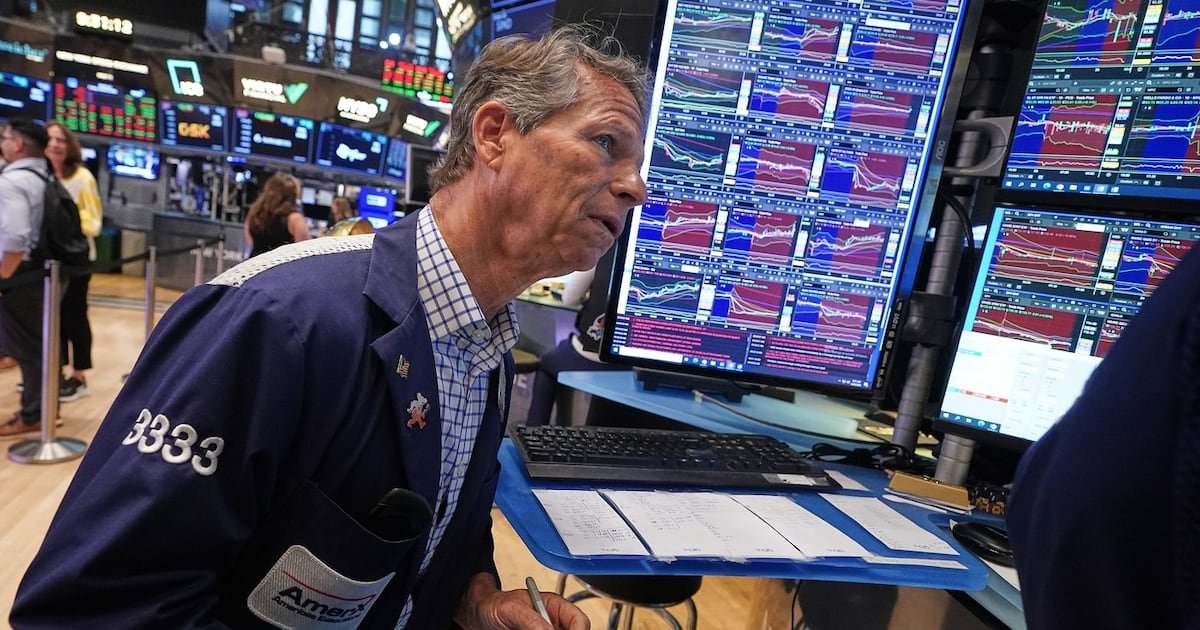
NEW YORK — Oil prices rose, and stock markets dropped in shaky trading worldwide after President Donald Trump raised doubts about the temporary truce in the war with Iran. The S&P 500 fell 0.3 per cent Wednesday after sinking as much as 1.1 per cent earlier in the day. The Dow Jones Industrial Average dropped 1.1 per cent after Trump said the agreement to pause fighting was over. The Nasdaq composite erased an early slump and rose 0.2 per cent after Trump said in the afternoon that the most recent fighting did not mean a return to full-scale war. Brent crude oil’s price climbed five per cent above US$78 per barrel.
THIS IS A BREAKING NEWS UPDATE. AP’s earlier story follows below.
NEW YORK (AP) — Oil prices rose, and stock markets dropped in shaky trading worldwide Wednesday after President Donald Trump raised doubts about the temporary truce in the war with Iran.
The S&P 500 fell as much as 1.1 per cent after Trump said the agreement to pause fighting was “over,” but the index then trimmed its loss to 0.3 per cent after Trump said the most recent exchange of fire with the Islamic Republic did not herald a return to full-scale war. They’re his latest mixed messages on what will happen with the war, which threatens to worsen inflation for the world.
The Dow Jones Industrial Average was down 550 points, or 1 per cent, with an hour remaining in trading, and the Nasdaq composite was 0.1 per cent higher after erasing an earlier loss.
The action was stronger in the oil market, where the price for a barrel of Brent crude climbed 5.2 per cent to US$78.02 and briefly topped US$80. That’s still below its peak from earlier in the war, when the price for the most actively traded contract reached nearly US$120. But the jump is unsettling because oil prices had just dropped back to where they were before the war.
The worry is that a continuation of the war will block the Strait of Hormuz and prevent the delivery of crude from the Persian Gulf to customers worldwide. That could worsen inflation, which economists expected would ease with oil prices, and in turn force the Federal Reserve and other central banks to raise interest rates.
Higher rates can keep a lid on inflation, but they also slow the economy and hurt prices for all kinds of investments.
Losses for stock markets in Europe accelerated, and oil prices climbed immediately after Trump said, “For me, I think it’s over” about the status of the ceasefire. He added that U.S. representatives can continue negotiations, “but I think they’re wasting their time.”
On Wall Street, stocks of companies in the housing industry helped lead the way lower. They were hurt by worries that rising Treasury yields in the bond market will mean higher rates for mortgages and chill the industry.
Builders FirstSource, which sells countertops, windows and other building supplies, fell 4.9 per cent. Homebuilders PulteGroup fell 4.9 per cent, and D.R. Horton sank 4.3 per cent.
Companies with big fuel bills also sank. American Airlines lost 3.6 per cent, and United Airlines fell 2.2 per cent.
Helping to offset those losses was a steadying for some influential stocks in the artificial-intelligence industry. They’ve been under pressure in recent weeks on worries that their prices shot too high and that AI may not produce enough productivity and profits to make all the investments in chips and data centers worth it.
Their swings carry a lot of weight on Wall Street because AI stocks have grown into some of the U.S. market’s biggest, giving their movements more effect on the S&P 500 than other stocks.
Nvidia rose 3.8 per cent, for example, and was the strongest force pushing upward on the S&P 500 because it’s the largest stock on Wall Street.
Broadcom climbed 5.2 per cent after Apple announced a multiyear commitment where Broadcom will design and produce custom components for its products. Apple said the agreement’s value could top US$30 billion.
In the bond market, Treasury yields rose with the price of oil. The yield on the 10-year Treasury briefly got near 4.60 per cent before pulling back to to 4.56 per cent. That’s up from 4.55 per cent late Tuesday and from just 3.97 per cent before the war with Iran began.
In stock markets abroad, European markets turned sharply lower after Trump made his comments, and Germany’s DAX lost 2.2 per cent.
In Asia, South Korea’s Kospi dropped 5.3 per cent and continued its sharp swings amid seesawing worries and euphoria about the AI stocks that dominate its market.
Hong Kong’s Hang Seng index was an outlier and rose 3 per cent.
Shares that trade in Hong Kong of Chinese AI startup Zhipu, known also as Z.ai and traded as Knowledge Atlas Technology, jumped 13.4 per cent.
A six-month lock-up period for “cornerstone” investors following its January trading debut in Hong Kong expires this week. China National Radio reported late Tuesday that nearly 70 per cent of Zhipu’s cornerstone investors are committed to stay on, despite previous worries that the lock-up period expiration could trigger a sell-off.
Zhipu’s share price has risen more than 1,300 per cent since its debut.
___
Stan Choe, The Associated Press
AP Business Writers Matt Ott, Chan Ho-him and Elaine Kurtenbach contributed to this report.