By Daniel Bradley
Indianapolis Business Journal
The ability to bet on the outcome of almost any event, anywhere, at any time now includes approval of drugs in development for conditions like Alzheimer’s disease, cancer and obesity.
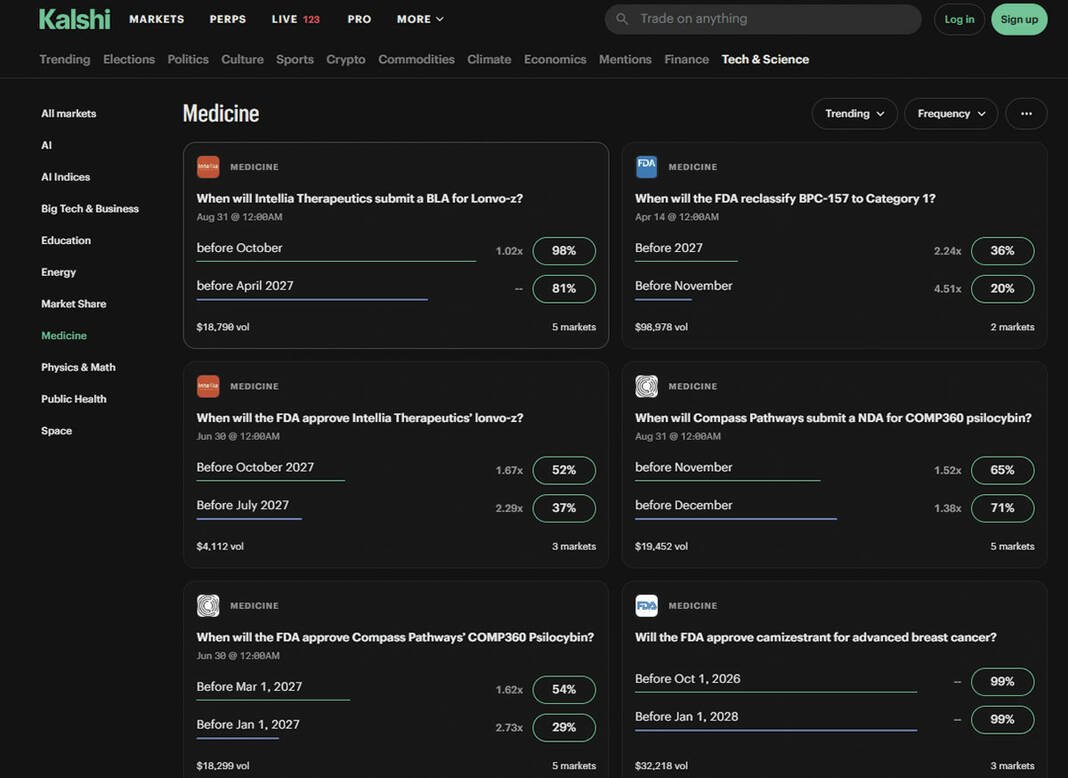
Prediction market websites Kalshi and Polymarket this year began letting people wager on U.S. Food and Drug Administration decisions. Kalshi also lets users trade event contracts, or wagers, on the outcomes of clinical trials as part of its pilot program introduced in July.
The drug development wagers are presented as yes-or-no questions, such as, “Will the FDA approve retatrutide?” As of Aug. 25, Kalshi traders gave a 91% probability that the highly anticipated weight-loss medication being developed by Indianapolis-based Eli Lilly and Co. will receive approval by July 1, 2028.
New York-based Kalshi, founded in 2018 by Tarek Mansour and Luana Lopes Lara, argues that the new betting markets will give researchers and the public better information about a drug’s potential to succeed, even though Kalshi wagers are based on information that is already public. The company is partnering with New York-based AppliedXL, which monitors and predicts the results of clinical trials. (Polymarket declined to comment for this story.)
For clinical trial bets, contracts rely on a public document to determine the outcome of the event subject to a trade, such as a registered primary end point on ClinicalTrials.gov, an FDA approval letter or an advisory committee vote record.
Only late-stage clinical trials run by established pharmaceutical companies that have finished enrolling participants are listed on Kalshi’s website.
“A public, accurate database of drug success metrics will enable researchers working on new drugs to have the best possible information while making decisions,” Kalshi spokesperson Jack Such said in an email. “This is important because even slight efficiency improvements in drug development will lead to more cures to more patients at faster rates.”
Mark Scallon, principal for Chicago-based Baker Tilly’s life sciences advisory practice, countered that the new markets present potential pitfalls for biosciences companies and patients hoping and waiting for a new medication. Unlike the stock market, which is based on an entire profile of a company, prediction markets are tied to a single event.
“Manipulating the stock market through insider trading and things like that are related to the company as a whole,” he said. “This is really the first time we’re seeing something that you can bet on that’s so specific as, ‘Is Company A going to get their molecule that’s in Phase 3 clinical trials right now approved?’”
Rivals Kalshi and New York-based Polymarket are the two largest prediction markets operating in the United States. The markets are regulated by the Commodity Futures Trading Commission, or CFTC, and include bets on sports and entertainment, economics, politics, business, technology, and now, pharmaceutical results.
The CFTC’s federal oversight allows Kalshi and Polymarket to operate in all 50 states, even those where gambling is illegal. However, the 9th Circuit Court of Appeals ruled Aug. 28 that states can regulate prediction markets like gambling.
About 20 states have sued the two prediction markets, alleging the companies effectively operate casino or gambling operations in violation of state gambling laws and have ordered them to shut down or stop operating in their states. And 44 states, including Indiana, have signed a letter arguing the platforms are gambling and should be subject to state gambling laws and taxes.
The Trump administration has backed prediction markets as suits have piled up.
Total trading volume on Kalshi and Polymarket increased from about $17 billion in January to nearly $53 billion in July, according to New York-based analytics firm The Block.
While most state-regulated casinos and sportsbooks are limited to people ages 21 and over, users as young as 18 can use prediction markets because they are regulated as financial markets. CNN reported recently that people ages 18 to 21 have traded an estimated $5.4 billion on Kalshi this year.
Unknown consequences
Clinical trial operators and pharmaceutical regulatory advisers told IBJ they worry about the ramifications for both drugmakers and patients who could live or die based on whether a medication has a successful clinical trial or receives regulatory approval.
Scallon said confidential information is one of the most valuable assets within a life sciences company. Most are not prepared for an era in which their work could appear on prediction markets, he said.
“Right now, I bet you 99% of companies out there have nothing mentioned in those governance documents specific to the prediction markets because no one’s really thought about it at this point that this was something that was going to happen,” Scallon said.
He also warned that some younger firms might not yet have robust compliance and governance structures in place at a time when prediction markets place financial value on material nonpublic information — data that is not available to the public that could affect a company’s stock price.
“My first thought was, ‘I wonder if any of my clients have even thought about this yet?’” Scallon said. “Everyone is at risk. However, the emerging biotech and medtech industries are particularly vulnerable [because] they don’t have the infrastructure yet.”
Scallon said his second thought was about patient care and whether someone with a stake in the game to get a questionable product approved could cause future safety problems.
Or, he said, “Did something not make it that could have saved millions of people’s lives if it had made it through the process, but … someone [who] had a high-stakes bet on it not being approved … somehow was able to manipulate the process so that it didn’t get approved? Does that mean all these people who could have a treatment or a cure to something never got access to it?”
David Tsai, who runs clinical trials at San Francisco-based Scribe Therapeutics, said prediction markets are introducing “a very perverse incentive into an ecosystem that’s so frail already.”
Tsai started an online petition to ban prediction markets from including wagers on clinical trials because the practice “threatens the very foundation of trust and integrity in biotechnology.”
He said people in his industry think prediction-market companies haven’t considered the consequences of allowing people to bet on clinical trials.
“Why come here? Why come into our industry?” Tsai said. “One of their arguments also is that somehow this will bring more transparency and force sponsors and pharmaceuticals to release more data. If they want to address that, we’re open to working with them, and we absolutely acknowledge that we should be doing more. But that’s not the way to do it.”
George Ball, an associate professor of operations and decision technologies at Indiana University’s Kelley School of Business in Bloomington, compared the risk of regulatory officials and pharmaceutical employees betting on pharmaceutical products to professional athletes participating in sports gambling. Since the U.S. Supreme Court struck down federal prohibitions on sports gambling in 2018, dozens of college and professional athletes have been arrested, suspended and banned from competing.
“You’ve got athletes that are betting when they shouldn’t and getting banned. That shouldn’t surprise anyone,” Ball said. “Just like if Polymarket and [Kalshi] get into betting on FDA decisions, it’s guaranteed a year from now, there’ll be an FDA analyst who makes $70,000 a year and gets in the marketplace. Or someone at a company who happens to get an early read gets in the marketplace. It’s just asking for that type of corruption.”
Tightening compliance
Large companies like Lilly are reemphasizing their policies now that prediction markets let people put money on their products.
“Lilly’s policies already prohibit employees from using company information for personal gain,” Lilly spokesperson Michael Jamison said in an email. “We are reinforcing this, as well as the prohibition of trading, betting, or passing on material nonpublic information, across our employee base.”
Aaron Schacht, CEO of Indianapolis-based BiomEdit, has held high-level positions at Lilly and Indianapolis-based Elanco Animal Health during his 36-year career. He said the key for publicly traded companies is to ensure that nobody in a firm is disclosing nonpublic information.
“In some ways, Kalshi might be an early indicator of where material nonpublic information is actually getting out,” he said. “If I’m a public company CEO and I see Kalshi’s market start moving in a direction that’s either consistent with my own belief about the risk profile of the asset or the clinical trial, then that’s an early warning sign that news is getting out.”
Kalshi’s Such said the company has safeguards to prevent manipulation and insider trading. The company prohibits pharmaceutical employees and anyone with access to material nonpublic information from betting on their own company’s products.
“We also consulted a litany of experts in the biotech field, including bioethicists, founders, former researchers at Eli Lilly, and more, during the design process of these markets,” Such said. “From these conversations, we implemented additional measures to prevent these markets from affecting research, such as waiting until after trial enrollment is complete to list markets.”
Jane Hartsock, a faculty investigator for the Indiana University Center for Bioethics, said there is still a danger that people who are within an arm’s length of research will participate.
“It’s very hard to address the extent to which people could be doing this who are connected to research, other than just, ‘Say you work for a pharmaceutical company,’” she said.
As pharmaceutical products make their way onto prediction markets, Scallon said, executives need to stay focused on what could be next: artificial intelligence transforming the prediction market industry.
“Artificial intelligence is really rapidly transforming this whole prediction market into really more of an automated, data-driven and competitive arena,” he said. “It’s not just that we need to protect it, but that we also need to battle with the robots to make sure the information isn’t getting out there and being traded on by the millisecond, which is what AI can do. That’s next.”