Elevated inflation is no longer just a Trumpflation story.
By Sean Williams –
Key Points
-
Despite bouts of heightened volatility, the Dow Jones Industrial Average, S&P 500, and Nasdaq Composite have surged under President Trump.
-
A few of Trump’s policies are directly responsible for lifting consumer prices.
-
The stock market’s and U.S. economy’s No. 1 catalyst has put Fed Chair Kevin Warsh and the Federal Open Market Committee (FOMC) in quite the pickle.
The stock market has endured some of its most volatile days in history under President Donald Trump. Nevertheless, the iconic Dow Jones Industrial Average (^DJI -1.93%), benchmark S&P 500 (^GSPC -3.70%), and tech-fueled Nasdaq Composite (^IXIC -5.28%) have averaged higher returns under Trump than under most other presidents since the late 1890s.
Some of this outperformance can be traced directly to Trump’s policies. The signing of the Tax Cuts and Jobs Act into law in December 2017 slashed the peak marginal corporate income tax rate from 35% to 21%, leading to record share buybacks by S&P 500 companies.
But the bulk of Wall Street’s gains comes courtesy of the artificial intelligence (AI) revolution and the ongoing AI data center build-out. AI is the largest addressable opportunity investors have ever seen, which explains why the Dow, S&P 500, and Nasdaq Composite have blasted to several record highs.

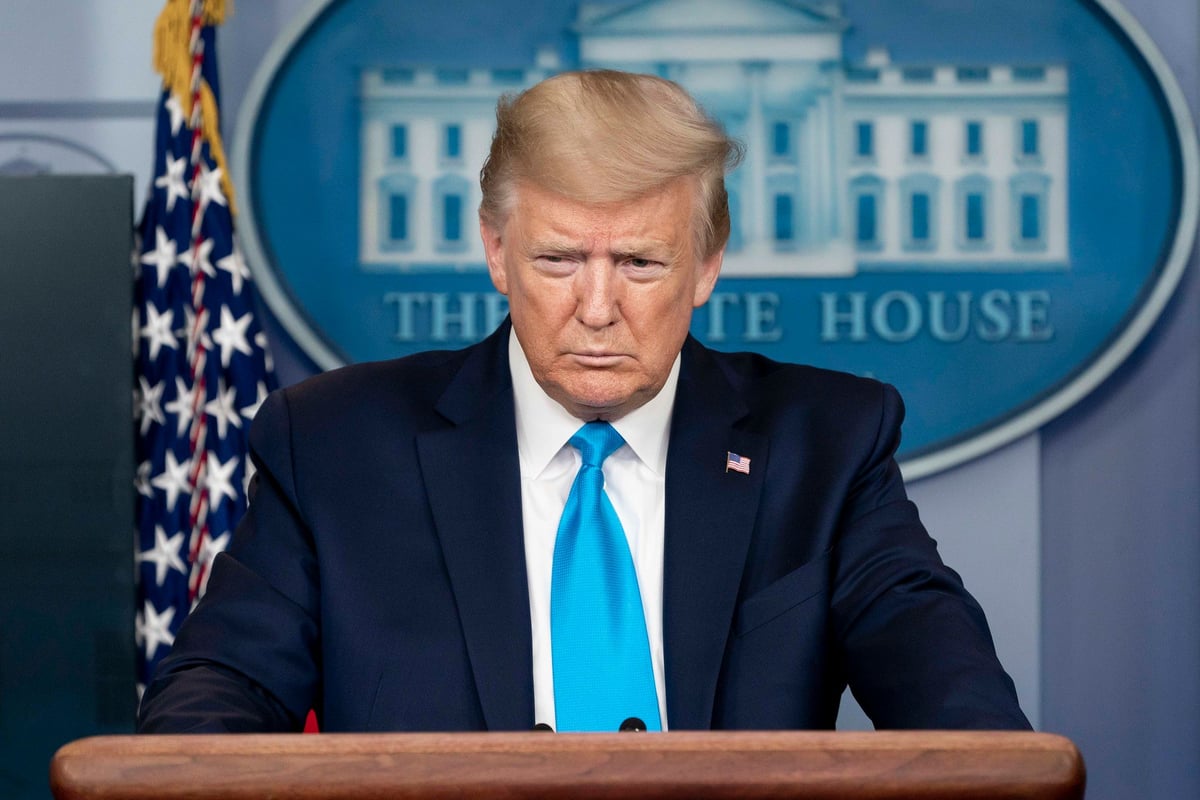
Persistently elevated inflation is a serious problem for President Trump’s economy and Wall Street. Image source: Official White House Photo by Andrea Hanks, courtesy of the National Archives.
But if things ever seem too good to be true on Wall Street, caveat emptor!
Both President Trump’s economy and the AI-driven stock market are in trouble, with persistently elevated inflation to blame. If Fed Chair Kevin Warsh and the Federal Open Market Committee (FOMC) get aggressive with interest rate hikes, it would likely spell the end of a four-year (and counting) bull market.
The issue is that elevated inflation is no longer just a Trumpflation story. The central bank has identified a new source of inflation that’s put FOMC policymakers in quite the pickle.
Trumpflation is becoming entrenched in the broader economy
Keep in mind that when the U.S. economy is growing, a modest level of inflation is expected. It’s a positive thing when strong demand for goods and services gives businesses some degree of pricing power.
But the theme of 2026 has been one of persistently elevated inflation. Whereas the FOMC aims for a “timely return” to the 2% long-term inflation target, Personal Consumption Expenditures (PCE), the Fed’s preferred inflation gauge, reached a three-year high of 4.1% in May and has been moving in the wrong direction, yet again, in recent months.
Trumpflation (i.e., inflation driven by the president’s policies) is certainly to blame for some of this pricing pressure.
New from the New York Fed: “By February 2026, tariffs had contributed 2.9 pp to goods price inflation, and without them goods prices would have fallen slightly.” About one quarter of every point in higher tariff rates shows up in consumer prices within one year. • A 10% across-the-board tariff yields a 2.6% rise in consumer goods prices after one year. • About two thirds of the increase comes from pricier imports, which get passed through quickly. • Another third comes from U.S. made goods, as producers face higher input costs and less import competition. This takes longer, about 6-12 months, to filter through.
— Nick Timiraos (@NickTimiraos) October 6, 2026
Donald Trump’s tariff and trade policy has been one clearly defined source of elevated inflation since the start of his second nonconsecutive term. Following the April 2025 “Liberation Day” tariffs, which the U.S. Supreme Court struck down in February 2026, the Trump administration has imposed sweeping global duties of 10% to 12.5% on more than 80 countries.
According to a recent report from three New York Federal Reserve economists writing for Liberty Street Economics (“How Fast Do Tariffs Pass Through into Consumer Prices?”), Trump’s 2025 tariffs added an estimated 2.9 percentage points to goods price inflation by February 2026. Goods prices would have fallen if not for the president’s tariffs.
The Trump-led Iran war is also pushing up prices. The Strait of Hormuz is a global crude oil choke point, and its closure has resulted in the largest energy supply disruption in modern history. Diesel prices climbed to an all-time high in September.
A slow but steady rise in Core PCE, which removes volatile food and energy costs, also suggests that Iran-war-driven inflation has reached the broader economy. The added transportation and supply chain expenses associated with the Iran war are translating into higher costs for consumers.

The newest source of inflation has put Fed Chair Kevin Warsh and the FOMC in a pickle. Image source: Official Federal Reserve Photo.
The Federal Reserve has identified a new source of inflation, and it’s a big problem
But Trumpflation is no longer the only driver of elevated inflation. Beginning in June and in each subsequent FOMC meeting, Fed Chair Warsh and his colleagues have homed in on a new source of inflation — one that may prove incredibly challenging to combat.
The FOMC’s minutes for the June meeting contained the following statement:
Core goods price inflation had risen relative to a year earlier, which the staff judged as largely reflecting the effects of tariffs and AI-related pricing pressures.
That’s right, folks… the AI infrastructure build-out, Wall Street’s and the U.S. economy’s No. 1 catalyst, is now officially a culprit for elevated inflation.
*KASHKARI: INFLATION DRIVEN BY SUPPLY ISSUES, INCLUDING AI-BUILD Here we go: AI as source of inflation
— zerohedge (@zerohedge) June 26, 2026
The Dow Jones Industrial Average, S&P 500, and Nasdaq Composite wouldn’t be where they are today without businesses spending a jaw-dropping amount of capital on AI hardware. A combination of otherworldly demand for data center infrastructure and ongoing supply shortages for graphics processing units and memory is affording AI hardware companies never-before-seen pricing power and record-high margins.
Likewise, the AI revolution is a key economic growth driver. President Trump favors as little regulation as possible to enable this infrastructure build-out.
However, rapidly rising prices for electronic components are adversely affecting consumers and businesses. Any device with a central processing unit, memory, or storage has likely endured a price hike. This means higher costs for smartphones, laptops, and other devices.
The AI boom is transforming one of the biggest deflationary forces into a key source of US inflation: Import prices for computer and electronic products surged +7.4% in the first 6 months of 2026, to 77.1 points, the highest since January 2016. This also marks a +8.0% YoY jump, the largest annual increase on record. This represents a historic reversal from a downtrend which persisted for over two decades. Between 2006 and 2019, computer and electronic product import prices fell -30%, as improving technology and manufacturing efficiency consistently pushed costs lower. Now, the AI investment boom is straining manufacturing capacity for semiconductors, servers, and electronic components, as companies race to build out AI infrastructure regardless of cost. The AI revolution has flipped technology from a long-term source of deflation into a major driver of inflation.
— The Kobeissi Letter (@KobeissiLetter) July 21, 2026
If Fed Chair Warsh and his colleagues maintain their focus on price stability and aggressively raise interest rates to do so, they could effectively cut off the stock market’s and economy’s No. 1 catalyst at the knees. Increasing borrowing costs for a partially debt-financed AI build-out would almost certainly slow this expansion, hurting growth projections and calling into question valuations amid the second-priciest stock market in history.
If the Fed does nothing, it could eventually prove just as damaging for Trump’s economy and the AI-driven bull market, with inflation continuing to march higher.
Regardless of the solution, the economy and Wall Street appear likely to pay the price.
Where to invest $1,000 right now
When our analyst team has a stock tip, it can pay to listen. After all, Stock Advisor’s total average return is 768%* — a market-crushing outperformance compared to 199% for the S&P 500.
They just revealed what they believe are the 10 best stocks for investors to buy right now, available when you join Stock Advisor.
*Stock Advisor returns as of November 21, 2026.