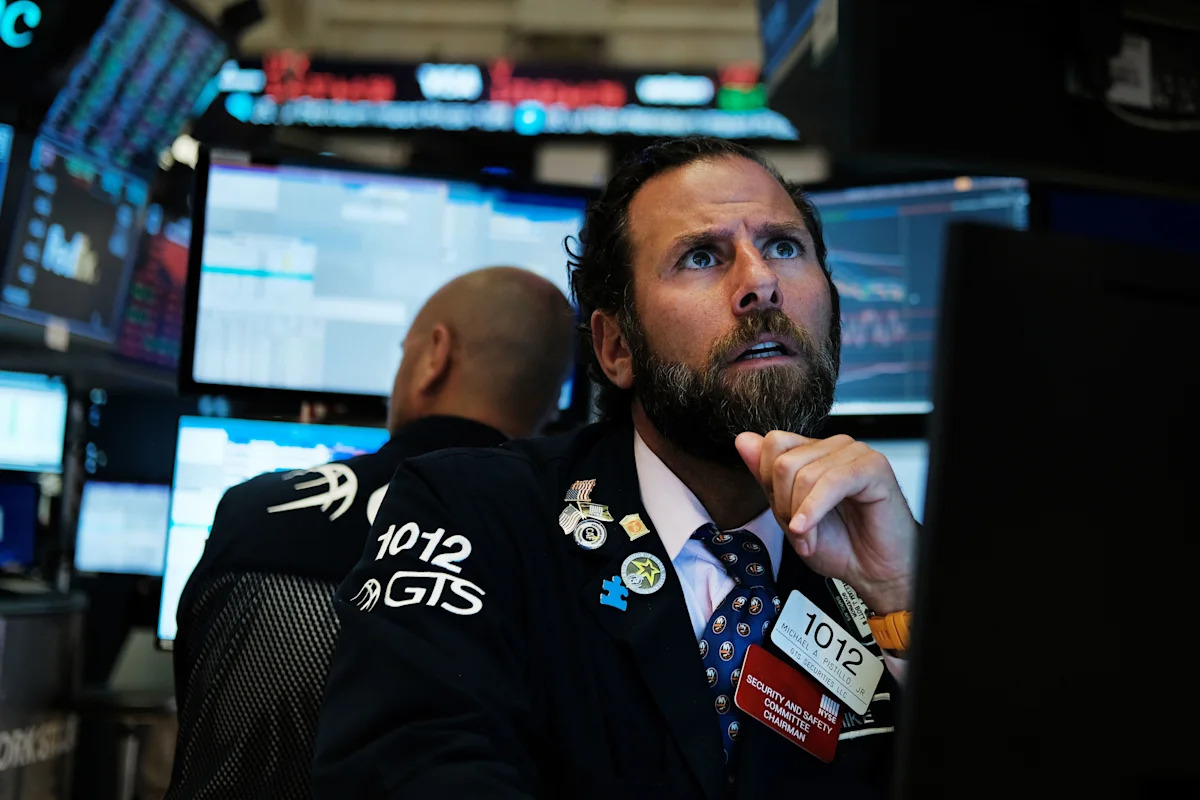
Markets were mostly lower on Thursday as oil prices and interest rates rose amid uncertainty about the U.S. position on a deal between Oman and Iran to reopen the Strait of Hormuz. While we’re still seeing strong data from the earnings calendar, price action today reflected both high expectations, as well as concern for the future.
The front-month West Texas Intermediate crude oil futures contract was up 3.6% to $77.93 per barrel. The Islamic Republic’s semi-official Fars news agency reported that Iran wants to ban American and Israeli ships from the Strait of Hormuz. Fars also said Iran is seeking compensation from the U.S. and Israel before they’re permitted to transit the passage from the Persian Gulf to global markets.
The 2-year Treasury yield climbed to 4.243% today from 4.179% on Wednesday; the 10-year was up to 4.664% from 4.617% and the 30-year rose to 5.205% vs 5.173%.
Sign up for Kiplinger’s Free Newsletters
Profit and prosper with the best of expert advice on investing, taxes, retirement, personal finance and more – straight to your e-mail.
Profit and prosper with the best of expert advice – straight to your e-mail.
Markets will get some big-picture perspective from the economic calendar when the Bureau of Labor Statistics releases the July jobs report before the opening bell on Friday.
Looking for more timely stock market news to help gauge the health of your portfolio? Sign up for Closing Bell, our free newsletter that’s delivered straight to your inbox at the close of each trading day.
At the closing bell on Thursday, the broad-based S&P 500 was down 0.2% at 7,710, the blue-chip Dow Jones Industrial Average had declined 0.9% to 53,885, and the tech-heavy Nasdaq Composite was lower by 0.06% at 26,348.
Sandisk’s guidance is soft
Sandisk (SNDK, -6.8%), which has been one of the best-performing S&P 500 stocks since joining the index in November, recovered from its intraday lows. But the flash storage specialist still suffered another steep loss because it fell short of great expectations.
Management reported exponential year-over-year growth at the top and bottom lines for its fiscal fourth quarter, and the tech stock topped Wall Street’s forecast for revenue and earnings per share.
But Sandisk guided to fiscal 2027 first-quarter revenue of $10.3 billion to $10.8 billion, and analysts wanted to see $10.82 billion. Margin guidance of 83% to 85% was also disappointing relative to a fourth-quarter figure of 84.6%.
Still, the bigger picture for earnings is bright, as Louis Navellier of Navellier & Associates notes, with 71% of companies in the S&P 500 reporting so far this season.
“Revenues are running 3.8% higher than analyst consensus estimates, while earnings are coming in at 7.3% higher than analyst consensus estimates,” Navellier says. Seventy-seven percent have reported revenue surprises, and 83% have reported earnings surprises.
“Interestingly,” Navellier concludes, “this is also the twelfth quarter in a row where earnings are exceeding sales growth, which is indicative of profit margin expansion.”
Why DAVE was so down today
Dave (DAVE, -15.1%) is a digital banking platform, and as recently as January it looked more like a small-cap stock than a mid-cap stock.
A year-to-date gain of more than 94% through Wednesday pushed it well into the higher market cap neighborhood. The reaction to Dave’s second-quarter earnings report is bringing it back down.
Dave, which describes itself as “one of the nation’s leading neobanks,” reported earnings of $4.12 per share, year-over-year growth of 48.2%. And revenue was up 29.7% to $170.8 million.
It’s those year-over-year growth figures: They’re slowing down. A year ago, Dave reported EPS growth of 263%. Then it was 196%, 93% and 64%.
The trajectory for revenue growth is a little like Hemingway’s line from “The Sun Also Rises.” It went from 64% a year ago to 63% to 62% to 47% when management reported first-quarter results.
Thirty percent annual revenue growth doesn’t exactly suggest “bankruptcy.” But there is a “gradually, then suddenly” feel to its failure to keep up with the law of big numbers.