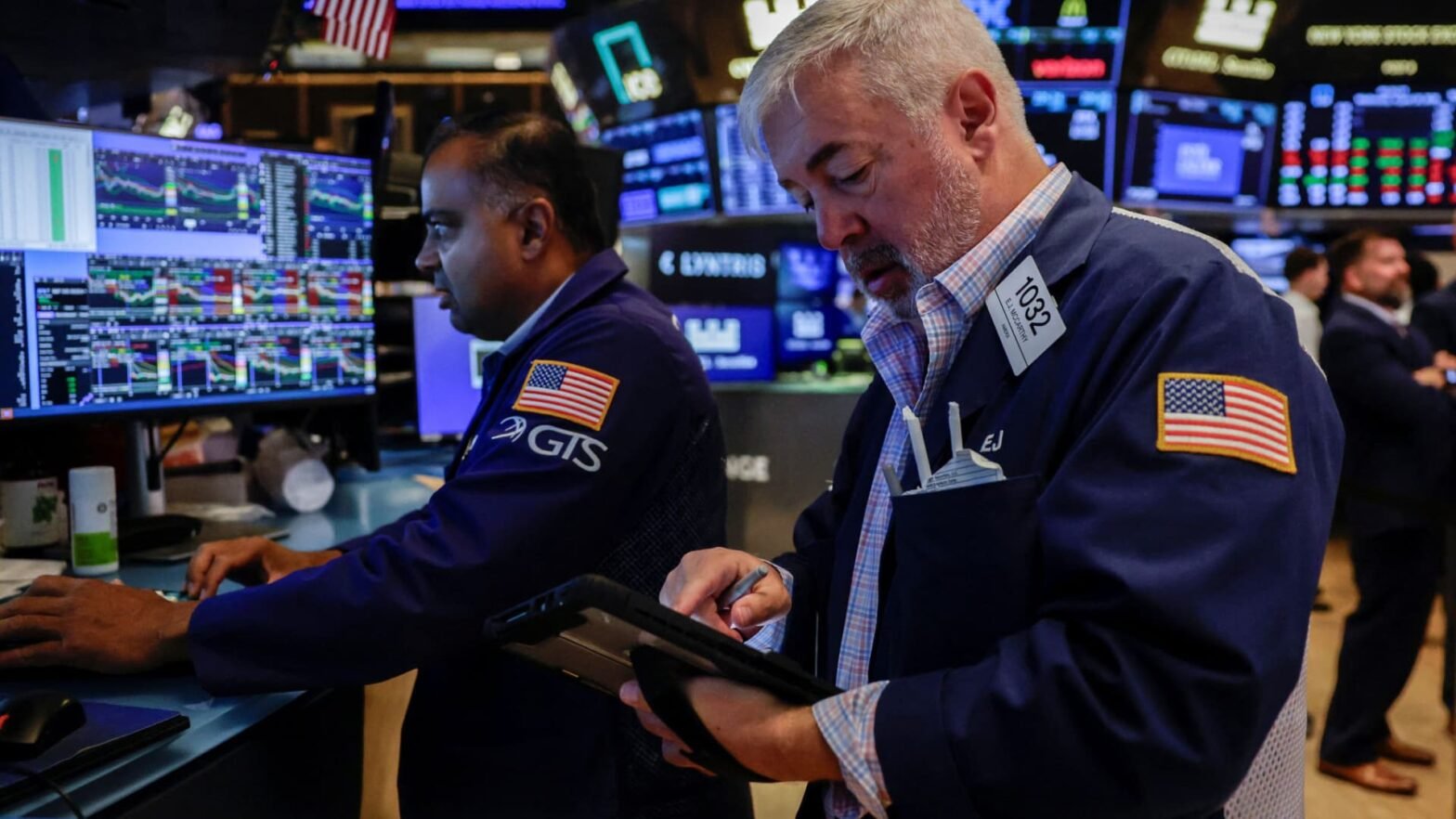
The S & P 500 on Friday posted its second straight losing month. But a look under the surface shows that was because of only a handful of stocks. The benchmark index closed out October with a 0.9% decline as investors questioned the sustainability of the artificial intelligence trade and oil prices surged on rising U.S.-Iran tensions. But the equal-weighted version of the S & P 500 did far better. That index jumped 4.9% in October, its biggest monthly advance since April. Bespoke Investment Group said the equal-weighted S & P had its best month relative to the market cap-weighted S & P 500 since April 2009 — and second biggest since 1990. The former outpaced the latter by 5.8 percentage points last month. The massive outperformance by the average stock underscores how dependent the market has become on the AI trade. The S & P 500 tech sector makes up 37% of the index’s overall market capitalization. Eight of the 10 largest S & P 500 stocks are technology or AI-related: Apple : $5.029 trillion market cap Nvidia : $4.931 trillion Microsoft : $3.875 trillion Amazon : $2.592 trillion Alphabet : $3.411 trillion Broadcom : $1.556 trillion Meta Platforms : $1.572 trillion Eli Lilly : $1.333 trillion Tesla : $1.58 trillion Berkshire Hathaway : $1.162 trillion To be sure, this may be positive for the stock market, if history is any indication. Bespoke noted that the median gain for the market cap-weighted S & P 500 is 4.6% three months after it lags its equal-weighted counterpart. One year out, that gain grows to nearly 13%. Fundstrat head of research Tom Lee thinks the S & P 500 can still top 8,200 before year-end. The benchmark closed Friday at 7,580.07. “The markets are going to exit the year strong,” he told CNBC’s ” Squawk Box ” on Monday. “We had a washout in the equal-weighted [index] earlier this year … So you’ve had most of the market correct.”
The average stock is having its best relative performance in decades as the AI trade falters
Nov 2, 2026