
Almost everywhere you look in the stock market, you can see signs of a bubble if you squint.
Valuations are unusually high. In fact, the CAPE ratio, which uses the last ten years of earnings, is nearly as high as it was when the dot-com bubble burst, which is its highest point ever.
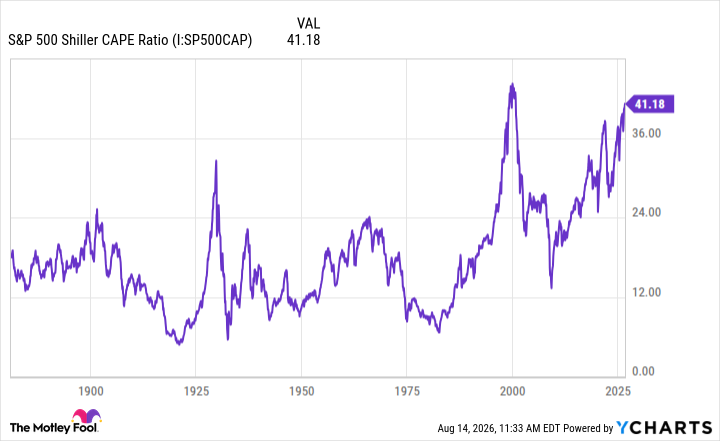
S&P 500 Shiller CAPE Ratio data by YCharts
Stock market bears are howling over what they claim is circular financing in the AI industry, or the way companies like Nvidia make investments in OpenAI and Anthropic, the AI frontier lab leaders, who then use that to contract out compute capacity from hyperscalers buying Nvidia chips. This arrangement, they claim, is a house of cards that will fall apart once AI demand slows.
Others point to the cyclical nature of the semiconductor industry, arguing that chip prices will eventually come down, especially in categories like memory, which will lead to a rude awakening for investors.
However, we now have some of the best evidence yet that the gains in the stock market are warranted, and that the AI boom is generating real, rather than paper, wealth.
According to Factset, the S&P 500 (^GSPC -0.17%) is expected to grow earnings per share by 50.4% this quarter, which is its fastest pace since Q2 2021, when it jumped 91.6% in the rebound from the start of the pandemic.
Clearly, this isn’t the first time the S&P 500 has grown earnings by 50%, but it is the first time this century it’s done so when it’s not rebounding from a previous drop in earnings, and that’s an important distinction.
The previous times this century that S&P 500 earnings jumped 50% or more were in 2021 during the pandemic, 2009-10 during the financial crisis, and in 2003 in the rebound from the dot-com bust.
In each of those cases, index earnings had fallen sharply due to the crisis at the time. That’s not the case right now. In fact, S&P 500 earnings were already at a record level before this year, as 2026 represents the fourth year of the AI boom.

Image source: Getty Images.
What history says about soaring S&P 500 earnings
S&P 500 earnings are skyrocketing in the current environment because of the AI infrastructure build-out. Profits at chip companies have catapulted higher since the launch of ChatGPT. Memory-chip maker Micron, (MU +2.30%) for example, reported net income up more than 10x in its fiscal third quarter, which ended in May, and counts toward the S&P 500’s Q2 cycle, reaching $28.2 billion in generally accepted accounting principles (GAAP) net income, up from $1.89 billion in the quarter the year before.
That surge alone accounts for roughly 4% of the S&P 500’s growth in Q2, and the boom extends well beyond Micron. Non-cash equity gains that have accrued to companies like Amazon and Alphabet due to the surge in Anthropic’s valuation, for example, also account for a significant percentage of S&P 500 earnings gains this quarter.
There’s no perfect comparison in history, but the period of time that seems to be the best analog for the current tech-driven infrastructure is the beginning of the dot-com boom in 1994.
In that year, internet infrastructure demand was starting to ramp higher, and demand for products from companies like Cisco, Intel, MCI Worldcom, and Micron began to take off. That year, S&P 500 earnings per share jumped 40%, helped by a broader rebound in cyclical and industrial stocks, as the tech sector was much smaller then.
Stocks were flat that year due to interest rate hikes, so it’s not remembered as the start of the dot-com boom, but it did lay the groundwork for the surge in stocks the following year.
What it means for the current stock market
The 1994 earnings surge how early in the AI boom we may still be. The data-center capacity and broader infrastructure build-out are just ramping up, as they did in 1994, and the productivity gains from AI are only starting to accrue. Start-up formation is beginning to surge, like it did in the dot-com era, though we have yet to see that impact the stock market significantly.
There are important differences between now and 1994. Stocks have already jumped from the AI boom, so at least some of the 50% earnings surge this quarter is priced in.
However, the earnings boom also seems to justify the high valuations in the market as the S&P 500 now has a forward P/E of just 20, putting the earlier-mentioned concerns about the CAPE ratio in perspective.
That looks like a fair price to pay for the index’s potential growth. If the 1994 analogy holds up, investors could be in store for more years of surging profits and the stock market gains to go with it.