On one hand, all-time highs in the S&P 500 (SNPINDEX: ^GSPC) are good news for investors. Stocks are up, the artificial intelligence (AI) boom is sparking excitement, and millions of American households are building wealth. Everyone should be happy, right?
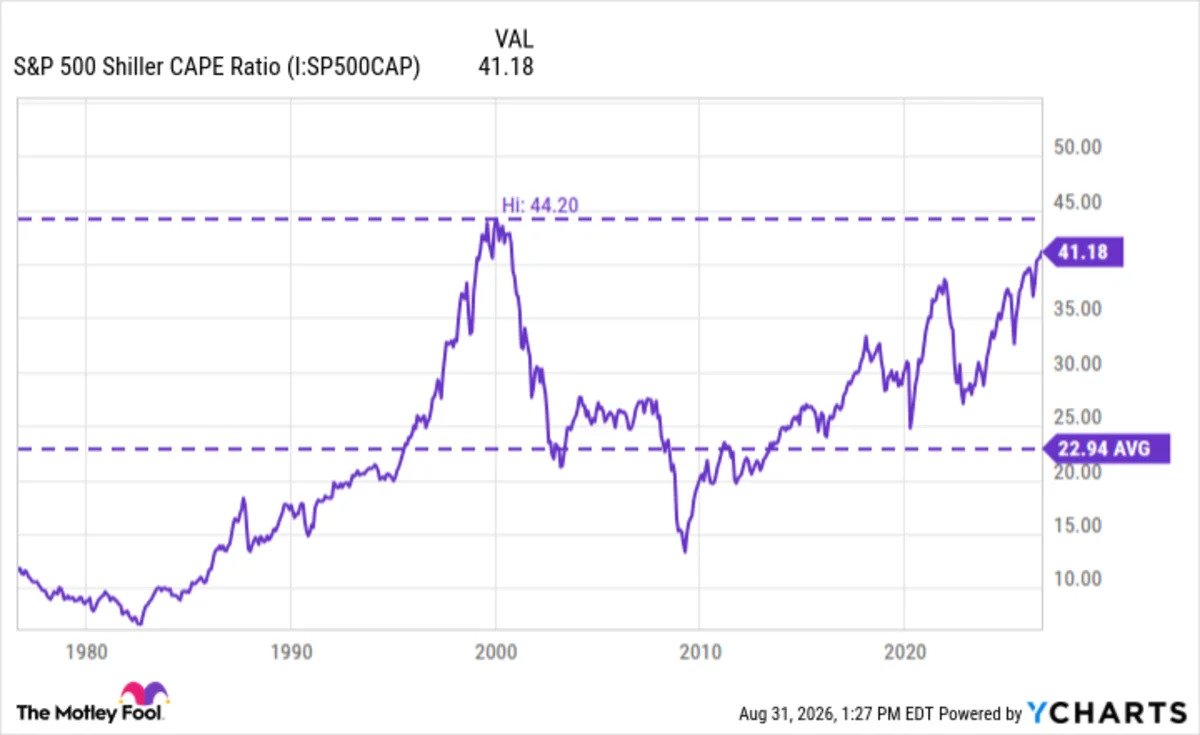
Wrong. Many investors are feeling nervous right now about the stock market because it’s been on such a strong run. They’re worried that the bull market can’t last much longer and that what goes up must come down. By some widely watched metrics — like the Shiller cyclically adjusted price-to-earnings (P/E) ratio, or CAPE ratio — the stock market is looking historically expensive. Future corporate earnings might not be high enough to justify today’s high share prices.
Missed Nvidia in 2009? This Rare Signal Is Flashing Again. In 2009, a “Double Down” signal flashed for a little-known chipmaker called Nvidia. For the first time in years, that same “Total Conviction” signal is flashing for a company 1/100th the size of Nvidia. Continue »
As an ominous sign, the S&P 500 index’s CAPE ratio hasn’t been this high since 2000. That was right before the dot-com bubble burst.
Does this mean that the stock market is doomed and we’re about to have a stock market crash? No one knows what’s going to happen next with stock market prices. Stock market history doesn’t always repeat itself. And even if there is a stock market downturn on the horizon, I’m going to keep buying stocks for the long term.
Let’s look at a few reasons why.

1. For a long-term investor, there’s never a “bad time” to buy stocks
Many people worry that the moment after they buy stocks, the market will crash.
Here’s the thing: It’s understandable to feel nervous about buying stocks. Stocks can be risky. Stock market downturns, corrections, and crashes happen.
But instead of worrying about what might happen in the stock market tomorrow, think about what is likely to happen over the next five to 10 years. Is the stock market the best place for your money to go to work for the long term? Most of the time, the answer is yes, and the broader stock market delivers strong gains for long-term investors.
The S&P 500 has delivered an average annual return of 10% over the past 98 years, since 1928. And that includes some of the worst economic crises and crashes in American history, like the Great Depression.
Most long-term investors should try to ignore the short-term anxiety and just buy a low-cost exchange-traded fund (ETF) that tracks the S&P 500. The Vanguard S&P 500 ETF (NYSEMKT: VOO) is one of the best. In the past 10 years, it’s delivered 15% annualized returns.