Yellow lights are flashing in the most important market on the planet: The US bond market.
The turmoil is being driven by a confluence of separate but related forces. The US war with Iran is heating up again, driving up US defense spending and the cost of oil, gasoline, diesel and jet fuel.
That energy spike is reinforcing inflation worries in a bond market already nervous about America’s $40 trillion mountain of debt. The yield on the benchmark 10-year Treasury, which is a measure of how much the US government pays to borrow more money, climbed on Wednesday to the highest level in nearly three years.
The bond market stress will make it more expensive for consumers to get a mortgage, for businesses to borrow and for Washington to pay the bills.
The risk is that this situation morphs into a doom loop, where the more the war intensifies, the more it will spook the bond market and slow the economy and stocks.
“It feels like there is no end to the inflation problem, the war or the deficit in the near term,” said Hardika Singh, economic strategist at Fundstrat Capital, an asset management firm.
The stock market gets most of the headlines, but the real power lies in the bond market. And bond market investors around the world have not been shy about flexing their muscles this summer.
In Germany, the 10-year yield recently hit levels unseen since 2011. The UK’s 30-year yield hit its highest since 1998. In Japan, which is suddenly dealing with a burst of inflation after decades of no inflation, the 10-year government bond crossed a 3% yield for the first time since 1996.
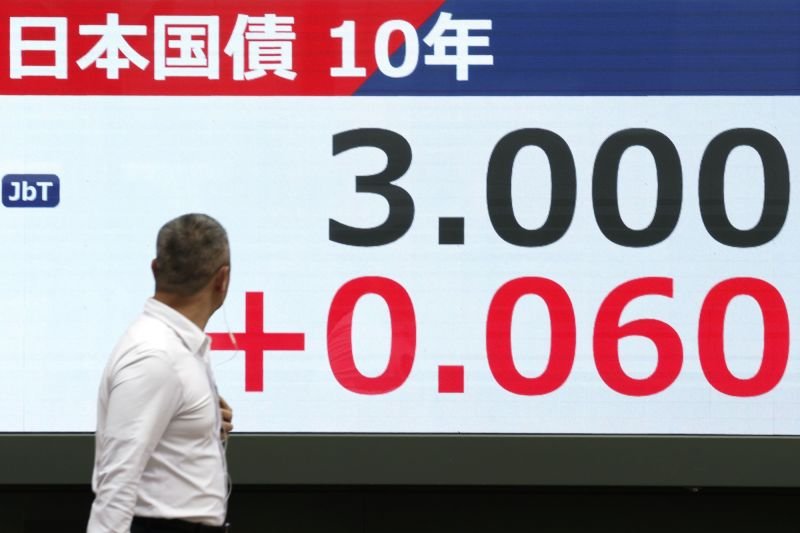
Higher bond yields are stealing thunder from stocks by providing what is traditionally thought of as a risk-free alternative. Since the US government has always paid its debts, the closer the US 10-year gets to 5%, the harder it is to justify buying tech stocks with historically high valuations that might come down.
When President Donald Trump shocked the world in late February by striking Iran, US officials stressed the conflict would be short, measured in weeks, not months.
But now the war has dragged out for more than six months, disrupting the flow of energy out of the most critical supply region in the world. That’s forced investors to reprice energy, inflation and bonds.
Workarounds – including sneaking oil tankers out of the Persian Gulf and China slashing its oil imports – have limited the damage. But the damage still exists.
Last month was the most expensive August for gas prices in US history, according to AAA. Diesel, a crucial fuel for the economy, has spiked 51% since the war started.
The longer the war lasts, the more it will push up already-elevated inflation and bond yields.
“This becomes a circular argument unless and until there is a credible way to get out of this war,” said Art Hogan, chief market strategist at B. Riley Wealth Management.
Investors suspect the Federal Reserve will seriously have to consider raising rates at its policy meeting later this month. Even Fed Chairman Kevin Warsh sounds more open to acting soon.
“The bond market can stop panicking when the Fed starts panicking,” said Hogan. “If the Fed shows they’re willing to start this battle with inflation, perhaps Treasury yields will cool off.”
Another problem for the bond market: Wars cost money – and those costs are typically not budgeted for.
The conflict with Iran is costing the United States billions of dollars in additional defense spending, forcing yet more borrowing.
Again, this is a global phenomenon.
Europe, Japan, and South Korea have all ramped up their defense spending due to various global threats.
“Sadly, it looks like the world has entered a new set of forever wars – and that’s very expensive,” said David Kelly, chief global strategist at JPMorgan Funds.
Higher bond yields typically slow the economy by raising the cost of capital.
Corporations have to pay more in interest for every factory they want to open. Small businesses are facing higher loan costs when they’re considering expansion.
Washington itself is hurt by higher interest on the national debt, which last month hit $40 trillion for the first time ever.
The United States has spent $931 billion on net interest so far this fiscal year alone, well ahead of the $804 billion spent on the national defense, according to Treasury.
Over the next decade, US spending on net interest is expected to surpass $16 trillion, according to the Peter G. Peterson Foundation, a fiscal watchdog group. That’s roughly triple the amount of credit card, student debt and car loans Americans owe.
“That is a conservative estimate, and those costs could be higher if rates rise further,” the Peterson Foundation wrote in a report on Wednesday.
Uncle Sam faces also new competition on the borrowing front from companies pouring money into artificial intelligence infrastructure.
Tech companies are spending trillions of dollars to build out the expensive AI boom, as they put up data centers all over the world – and much of that is being financed through the bond market, crowding out Washington’s own borrowing needs.
Bond rates got so high last month that Treasury Secretary Scott Bessent surprised the market with a controversial intervention.
His plan – promising to at least double Treasury buybacks – worked, but only for a few hours. The bond sell-off quickly resumed, with rates surpassing pre-intervention levels.
“It massively flopped,” said Fundstrat’s Singh. “If anything, this may have made the problem worse. Bessent showed his hand. To investors, it was like, ‘Oh my gosh, he’s worried. We should be too.’”
JPMorgan’s Kelly said Bessent’s intervention has not been effective because it did nothing to change the structural problem of sky-high deficits.
“It’s just moving around a bunch of borrowed money. That’s not going to move the needle,” said Kelly. “Unless they can find a way to truly change the trajectory on our debt, the government is powerless to stop this. We’ve maxed out the credit cards.”
Kelly doubts that even a modest decline in oil prices will be a game-changer for the bond market because of the sheer amount of borrowing that’s required.
“The only fool-proof way to get a major bond market rally is to have a massive recession,” he said. “That would do it.”