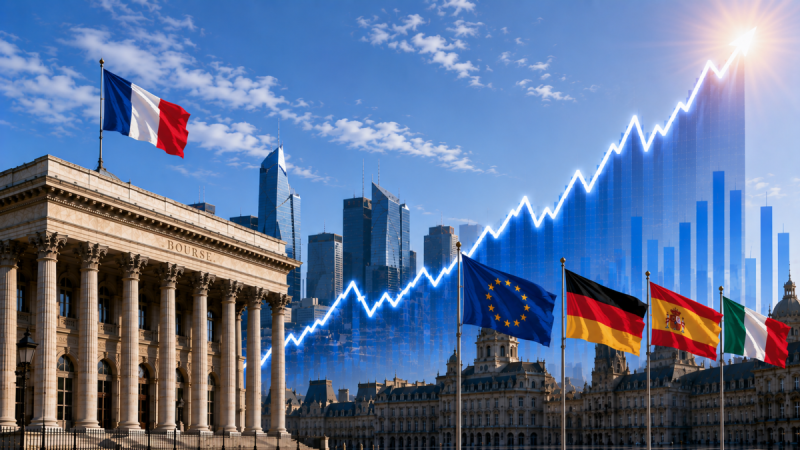
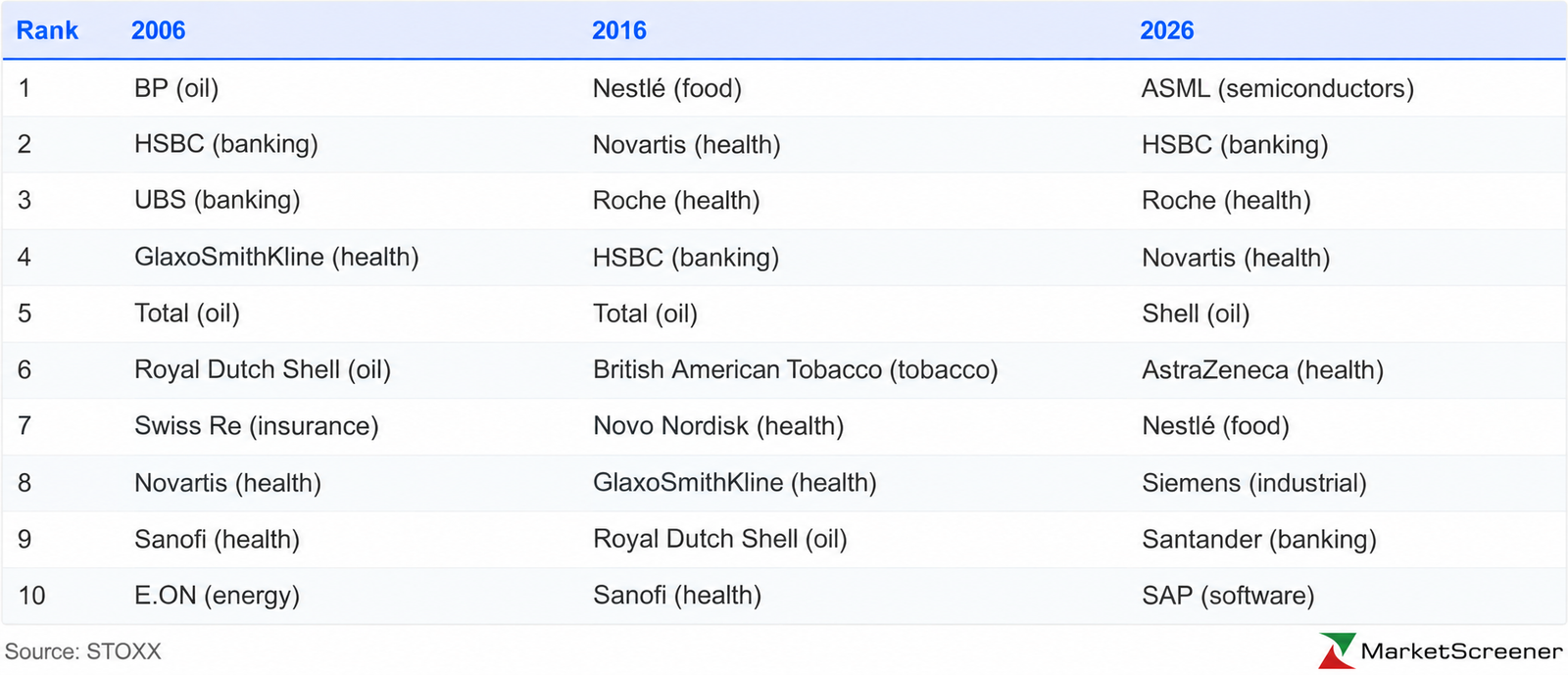
Oil majors and banks in 2006, pharma and defensives in 2016, technology and industry today: the ranking of the biggest weights in the Stoxx 600 tells the continent’s economic story in ten lines, with its comeback kids, its vanishings and one shooting star.
Try this: ask around which company carries the most weight in Europe’s stock market. Twenty years ago, the answer was a British oil major. Today, it is a Dutch maker of machines that few people could even describe. In between, Europe’s listed market has changed its face, in step with crises, technological revolutions and bouts of enthusiasm.
The big disappearances
The 2006 lineup looks like a snapshot of a slightly different world. Oil ruled, with BP, Total and Shell in the top six. Banks and insurance took three slots. Then the crises hit.
BP saw its fate turn in 2010 with the Deepwater Horizon oil spill in the Gulf of Mexico. The total bill rose to around $65bn. Number one in 2006, the oil major is now worth only about $112bn in market value, far from the top spots.
UBS, third in 2006, was one of the major victims of the subprime crisis, those US home loans granted to fragile borrowers. In October 2008, the Swiss state had to inject 6bn Swiss francs. In parallel, the central bank set up a vehicle tasked with taking over up to $60bn of toxic assets, securities that had become almost impossible to sell. Its compatriot Swiss Re has also left the podium.
Germany’s E.ON, meanwhile, had to reinvent itself in an energy sector that was deeply reshaped in Germany. As for GlaxoSmithKline, present in 2006 as in 2016, it no longer appears in the ranking. In the meantime, it spun off its consumer-health unit, Haleon.
The newcomers
While some exited the stage, others quietly rose in importance.
ASML is the symbol of this new era. The Dutch group is the world’s only maker of the most advanced lithography machines. They are essential to etch the latest-generation chips, the ones used in particular in artificial-intelligence servers. In April 2016, ASML still accounted for only 0.45% of the index, far behind dozens of other stocks. It now holds the top spot. With roughly $653bn in market value, it is worth almost twice as much as its runner-up, Roche.
SAP and Siemens embody the other side of this transformation: enterprise software for the former, automation and industrial electrification for the latter. Two German companies, where Germany in 2006 was represented only by a utility.
Finally, Santander marks the return of euro zone banks, which have benefited in particular from higher interest rates after a decade of zero rates.
Novo Nordisk, the shooting star
No trajectory is as spectacular as Novo Nordisk‘s. Seventh in 2016, the Danish drugmaker then enjoyed a meteoric rise thanks to its diabetes and obesity treatments, Ozempic and Wegovy. On September 1, 2023, it unseated LVMH as Europe’s largest market capitalization.
The fall was almost as fast. Competition from Eli Lilly, lowered forecasts, clinical disappointments: the stock has lost about 70% from its mid-2024 peak, when the company was worth nearly $636bn. With roughly $176bn in market value, it is now only the 19th-largest listed group in Europe. And the series continues. As recently as Monday, the stock fell 7.7% after an investor day that failed to convince. A useful lesson: in the stock market, even a revolutionary product does not protect against excessive optimism.
The unshakables
Three names make it through the 20 years without ever leaving the ranking: HSBC, Novartis and Shell. A bank, a drugmaker and an oil major. Not exactly magazine-cover material, but a rare quality in the market: staying power. Health care, in particular, remains the bedrock of Europe’s listed market, with three representatives in 2026 (Roche, Novartis and AstraZeneca) and as many as five in 2016.
Be careful, though, of a false impression. If companies are ranked by total market value, L’Oréal climbs to 10th in Europe, just ahead of LVMH. But the Stoxx 600 weights them by free float, meaning the portion of shares actually available for trading. L’Oréal’s shareholder base is indeed highly concentrated, between the Bettencourt family and Nestlé, just like LVMH’s, controlled by the Arnault family. As a result, they weigh less in the index than their true size would suggest, and Santander, with a far more widely held shareholder base, takes the 10th spot.
What the ranking says about current trends
The 2026 top 10 tells the story of a gradual shift toward technology and industry. Semiconductors with ASML, software with SAP, electrification with Siemens. Artificial intelligence is already there, through the machines that make the chips.
Defense, one of the market’s big themes in recent years, is not there yet. Aerospace and defense groups are getting closer, though: Airbus, Rolls-Royce and Safran are all above $150bn in market value. The progress is all the more notable given that in 2016, Rheinmetall accounted for barely 0.04% of the Stoxx 600, and STOXX even classified it among auto stocks. Novo Nordisk’s example also reminds that a place in the top 10 guarantees nothing for the future.
One last point speaks directly to savers. Holding a Stoxx 600 ETF means mechanically holding these giants, in proportion to their weight. Yesterday, the passive investor was mainly betting on oil and banks. Today, that investor is leaning more on health care and technology, without necessarily choosing to.