
Wall Street has gone quiet. The calendar says that’s about to change.
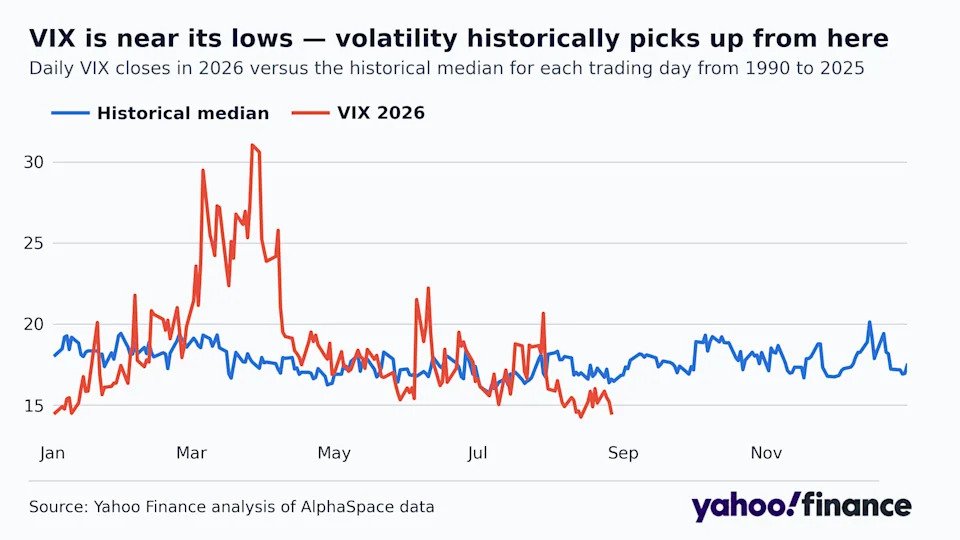
The CBOE Volatility Index (^VIX) fell to 14.13 on Friday, its lowest level of 2026. That’s a long way from the spring, when volatility briefly exploded higher with Iran war headlines before spending the summer grinding back down.

That calm tends to fade right around now.
The VIX has historically started climbing around this time of year. Its median level since 1990 sits around 16.5 in late August, rises toward 18 by mid-September, and reaches roughly 19 in early October.
That doesn’t mean stocks are destined to fall.
The VIX measures the 30-day volatility implied by S&P 500 options, or roughly how much movement options traders are pricing into the market. It says nothing about which direction the movement will take.
That distinction can get lost whenever the VIX starts rising. Stocks can rally even with elevated volatility, and they can drift lower even with subdued volatility. What changes this time of year is the range of possible outcomes. It tends to get wider.
September has historically been the weakest month for the S&P 500 (^GSPC) since 1950, with an average decline of 0.6%. But the more dramatic seasonal move comes afterward.
Midterm election years sharpen that pattern.
Stocks have often struggled from late summer into early fall during midterm years before recovering later in the season.
S&P 500 seasonality since 1950
So the scary-looking part of the calendar has historically contained a twist.
September has been weak. October and November have been much stronger, especially in midterm years.
None of this turns the calendar into a trading system. Seasonality is a tendency built from many wildly different markets, and 2026 has already written plenty of its own script.
With the VIX wrapping August with a 14-handle, the market has plenty of room to become more volatile without anything truly unusual happening.
If the VIX climbs back toward the high teens into September and October — even the low-to mid-20s — Wall Street may not be breaking down.
It may just be getting back on schedule.
Jared Blikre is the global markets and data editor for Yahoo Finance. Follow him on X at @SPYJared or email him at jaredblikre@yahooinc.com.
Click here for in-depth analysis of the latest stock market news and events moving stock prices
Read the latest financial and business news from Yahoo Finance