Will Ebiefung, The Motley Fool
5 min read
Over the long haul, investing in the stock market is one of the best ways to build wealth, but it isn’t a get-rich-quick scheme. And periods of unusually high returns are often followed by sharp declines as market expectations and corporate valuations come back down to Earth.
This historic pattern is particularly relevant for investors right now. During the past four years, the benchmark S&P 500 (SNPINDEX: ^GSPC) has grown by a whopping 21% annually — more than double its 100-year average return of about 10%. Let’s dig deeper into what history suggests might happen next and discuss strategies investors can use to stay ahead.
Missed AI’s “Act 1”? Act 2 Could Be 14x Bigger. Most investors think they missed the AI boat because they didn’t buy Nvidia in 2005. But according to our analysts, we’re only at the end of “Act 1″—the R&D phase. “Act 2” is the global rollout. Continue »
This has only happened three times
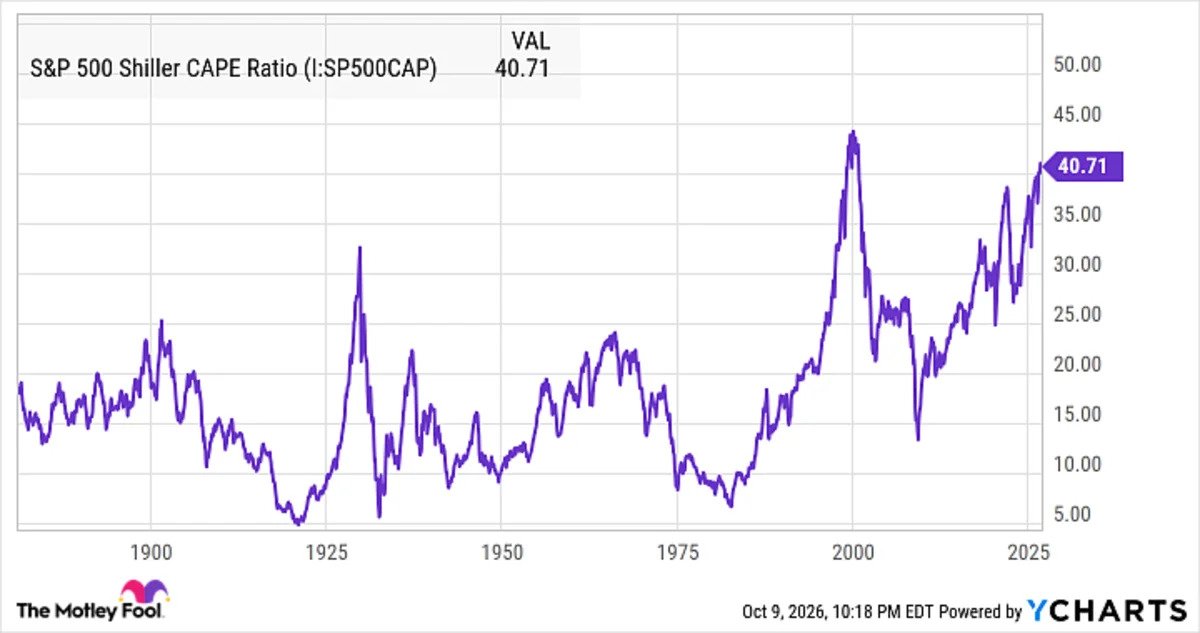
In 1988, Nobel Prize-winning economist Robert Shiller introduced the cyclically adjusted price-to-earnings (CAPE) ratio. The metric compares the value of the S&P 500 to its 10-year average inflation-adjusted earnings to highlight periods of long-term overvaluation in the market.
During the past 156 years, it has only surpassed 32 three times.

S&P 500 Shiller CAPE Ratio data by YCharts
The first peak was right before the Great Depression in 1929, when it hit 32.6. The second time was during the dot-com bubble in 1999, when it peaked at 44.2. The third time is happening right now at almost 41. And it isn’t hard to see why.
Optimism surrounding generative artificial intelligence (AI) has led to rapid gains in the tech stocks expected to benefit from the trend — much like internet companies boomed in the late 1990s. But while the CAPE ratio shows us that stocks are historically pricey, it doesn’t tell us exactly when Wall Street will decide the market has become too pricey and start a big sell-off. That said, the dynamics of the AI industry itself may give even better insights into how this bull run could eventually end.
History is not repeating, but it is rhyming
Although the AI boom looks similar to the dot-com bubble on the surface, there are some key differences. Bulls will argue that the late-’90s boom was driven by speculative, unprofitable internet stocks, while the current boom is being led by stable, profitable giants.
The problem is that it is impossible to separate the fortunes of profitable AI infrastructure providers from the unprofitable consumer-facing frontier models their chips and data centers are designed to serve. Companies like OpenAI and Anthropic are already showing signs of unsustainability.