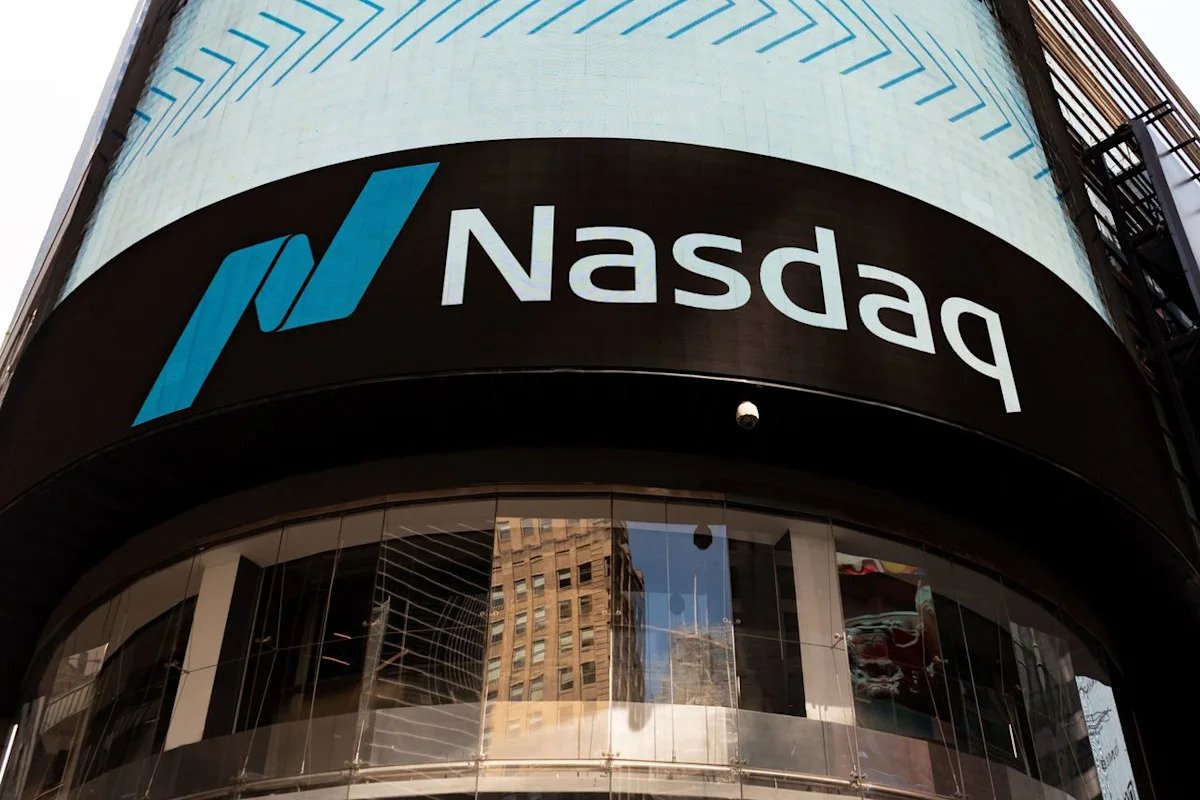
US Stock Market Surging Today: Dow Jumps Record 538 Points as S&P 500 and Nasdaq Rally on Final Day of April – The US stock market is surging today in a rally that feels less like a single news event and more like a dam finally breaking. On the final trading session of April 2026, the Dow Jones Industrial Average jumped a record 538 points, crossing 49,400 for the first time, while the S&P 500 climbed 0.41% and the Nasdaq Composite edged higher by 0.16%. The move caps what is shaping up to be the strongest month for American equities since late 2020 — and it comes packed with signals that investors have been waiting months to read clearly.
What’s actually driving the US stock market surge today is not one catalyst but a collision of several forces arriving at once. Earnings from four of the world’s most valuable companies landed overnight. Economic data on growth and inflation came in close enough to forecasts to avoid panic. And oil — the lurking threat that spooked markets all week — pulled back sharply after briefly hitting a four-year high above $126 a barrel. When the smoke cleared, buyers stepped in with conviction.
The result is a market that, at least for today, has found its footing. The Dow is pacing for its best monthly gain since November 2024. The S&P 500 is up 9% in April alone. The Nasdaq, buoyed by a technology sector that continues to print money even under tariff clouds, has surged 14% this month — its best performance since April 2020, when the world was still figuring out how to spell “pandemic.”
Why US stock market surging big today? Dow Jones, S&P 500 and Nasdaq rally as Dow jumps record 500 points
On April 30, 2026, investors are watching a rare alignment of earnings strength, cooling yields, and resilient economic signals. The Dow Jones Industrial Average jumped over 500 points to 49,400. The S&P 500 crossed 7,165. Meanwhile, the Nasdaq Composite held steady gains near record highs.
But beneath these numbers lies something more subtle. Markets are not just reacting. They are recalibrating expectations. Strong earnings from industrials like Caterpillar, explosive semiconductor momentum from Qualcomm, and steady macro signals are creating a rare “confidence window.” Even geopolitical risks like Iran tensions and oil spikes are being absorbed rather than feared.
April itself tells a bigger story. Nasdaq is up nearly 14% this month. S&P 500 has gained around 9%. Dow has added about 5%.
Caterpillar, Qualcomm, and the Earnings Stories Lifting the Dow and Nasdaq Today
The Dow’s 538-point surge today has a hero, and it is wearing steel-toed boots. Caterpillar shares rocketed nearly 9% on Thursday, adding enormous weight to the blue-chip index after the heavy machinery giant reported results that reminded investors why industrial America remains a formidable earnings machine. Infrastructure spending, mining demand, and energy construction are all running hot — and Caterpillar sits at the center of all three.
Then there is Qualcomm. The San Diego-based semiconductor company announced it is entering the custom silicon market for data centers, confirming initial shipments to a leading hyperscaler in the December quarter.
Qualcomm shares surged 14%, pacing the entire S&P 500 and Nasdaq, as JPMorgan analysts called the move a “significant positive” for the firm’s long-term diversification and a catalyst for share re-rating. For a stock that entered Thursday down 9% on the year, this is a meaningful reversal — and it signals that the AI infrastructure buildout still has room to pull in unexpected winners.
Royal Caribbean and Eli Lilly provided the pre-market spark. Royal Caribbean shares jumped 9.5% after reporting adjusted earnings of $3.60 per share against analyst expectations of $3.21, with revenues rising 11% year over year to $4.45 billion. The company trimmed its full-year outlook slightly due to fuel costs and Middle Eastern itinerary disruptions, but underscored that April bookings were still running ahead of the same period last year at record prices.
Eli Lilly surged 8.5%, reinforcing the pharmaceutical sector’s status as a ballast asset in uncertain times.
What the GDP and PCE Data Really Tell Us About This Stock Market Surge
Behind the headline moves, the US stock market’s surge today is grounded in economic data that, when read carefully, tells a nuanced story. First-quarter GDP came in at 2.0% — below the 2.2% economists had penciled in, but dramatically above the 0.5% posted in Q4 of last year. That acceleration matters more than the miss. An economy that looked like it was stalling six months ago is now growing at a pace that supports corporate revenue assumptions.
The March Personal Consumption Expenditures price index, the Federal Reserve’s preferred inflation gauge, matched expectations precisely — a 0.7% month-over-month increase and a 3.5% year-over-year rise. That is not a number that signals victory over inflation. But it is also not the upside surprise that would have rattled rate-cut timelines. Markets read it as confirmation that the Fed’s “higher for longer” posture is stable, which is paradoxically comforting — uncertainty is more damaging than a known cost of capital.
The 10-year Treasury yield dipped to 4.39% from 4.43% the prior session, a small but meaningful move that eases pressure on equity valuations. When long-duration yields fall even modestly, the present value of future corporate earnings rises — and in a market where technology companies trade on years of projected cash flow, a few basis points of yield compression translates directly into higher justifiable price-to-earnings multiples.
“As long as the economy continues to grow and companies are able to grow earnings, we can see higher stock prices even in the face of higher energy prices and inflation.” — Chris Zaccarelli, Chief Investment Officer, Northlight Asset Management
The Magnificent Seven Earnings Split — and Why the Dow and S&P 500 Are Still Rising
Wednesday’s after-hours earnings from four trillion-dollar technology giants produced a deeply mixed scorecard, yet the US stock market is surging today anyway. That tells us something important about how investors are separating signal from noise.
Alphabet rose 6.5% on strong advertising revenue growth and AI-monetization traction. But Meta fell 9.5%, Microsoft dropped 4.5%, and Amazon slipped 1.5% despite solid underlying numbers — investor expectations had simply run too high, and any shortfall against whisper numbers was punished.
This earnings divergence reveals a maturing phase in the artificial intelligence investment cycle. In 2023 and 2024, investors rewarded every company that said “AI” in an earnings call.
In 2026, the market is asking harder questions — which companies are converting AI investment into measurable revenue growth, and which are still promising returns that haven’t materialized? Alphabet’s advertising business and Qualcomm’s silicon design wins are passing that test. Meta’s heavy infrastructure spending without proportional near-term returns is failing it.
Apple’s after-bell report remains the final piece of today’s puzzle. Shares edged higher in Thursday trading as investors positioned for a print that could validate or undercut the rally. Apple’s supply chain exposure to China — combined with tariff pressures that have complicated iPhone manufacturing economics — makes its guidance commentary as important as the headline numbers.
The Nasdaq is up 14% in April — its best single month since April 2020.
Oil’s Sudden Retreat and Why It Matters for the Stock Market Rally
Perhaps the most dramatic subplot of today’s US stock market surge is what is happening in the oil market, not in the equity market. West Texas Intermediate crude briefly topped $126 per barrel early Thursday after Axios reported that President Trump would be briefed on new military options against Iran. That spike sent energy prices to a four-year high and threatened to revive stagflation fears that had already been weighing on sentiment all month.
Then oil reversed. Sharply. By midday, WTI had fallen 1.7% to $105 a barrel, with Brent crude sliding 3% to $114.50. The reversal suggests traders concluded the Iran briefing reflected contingency planning rather than imminent action — and that the initial geopolitical premium was overdone. For equity markets, lower oil is a direct input cost relief for airlines, retailers, shipping companies, and manufacturers. It is also an inflation dampener at a moment when the Fed is watching energy prices closely.
Gold’s simultaneous rise to $4,635 an ounce — up 1.6% on the day — reflects the underlying tension that has not been resolved. The geopolitical premium is not gone; it has merely migrated from oil into safe-haven assets.
Bitcoin held near $76,300, while the US dollar index fell 0.7% to 98.30. Taken together, these moves suggest investors are cautiously optimistic, not euphoric — which is probably the healthiest possible foundation for a sustained rally.
Is the April 2026 Stock Market Surge Sustainable — or a One-Day Bounce?
The US stock market surging today on the final day of April invites an obvious question: how much of this is genuine recovery, and how much is month-end positioning and earnings relief? The honest answer is that it is both — and the distinction matters less than the underlying conditions. Corporate earnings, while mixed at the top, are still growing.
The labor market remains resilient. GDP is accelerating from a soft patch. And the Fed, despite keeping rates steady at its most recent meeting, is not actively tightening further.
The risks have not disappeared. Geopolitical uncertainty around Iran, ongoing tariff friction with China affecting semiconductor supply chains, and elevated fuel costs are all real headwinds.
Qualcomm’s own guidance acknowledged that handset revenues from Chinese customers would hit a trough in Q3 before recovering. Stellantis fell 6% on weak auto demand data. These are not footnotes — they are material risks that could compress multiples if they worsen.
But the market’s behavior today — buying Alphabet’s AI advertising growth, bidding up Qualcomm’s data-center entry, rewarding Royal Caribbean’s resilient consumer demand — suggests the investing public has a framework for what it believes in and what it doesn’t. That selectivity is the hallmark of a market entering a new, more discriminating phase of a bull cycle.
The Dow surging 538 points is not a signal that all risks are priced out. It is a signal that enough earnings, data, and events landed in the right column today to make buyers more confident than sellers. In markets, that is always enough.
| Asset / Indicator | Level | Change | Note |
| Dow Jones | 49,400.37 | +1.10% | Best month since Nov 2024 |
| S&P 500 | 7,165.01 | +0.41% | +9% in April |
| Nasdaq | 24,712.39 | +0.16% | +14% in April |
| 10-Year Treasury | 4.39% | -4 bps | Down from 4.43% |
| WTI Crude | $105/bbl | -1.70% | Reversed from $126 high |
| Brent Crude | $114.50/bbl | -3.00% | Off $126 surge |
| Gold | $4,635/oz | +1.60% | Safe-haven bid holds |
| Bitcoin | $76,300 | +1.30% | Off overnight lows |
| USD Index | 98.30 | -0.70% | Dollar weakens broadly |
| Q1 GDP | 2.0% | — | vs 2.2% est; Q4 was 0.5% |
| PCE (YoY) | 3.5% | — | In line with expectations |